

Echo Go+ Hydrogen Water Bottle
Editorial verdict · Editorial verdict (research-based)
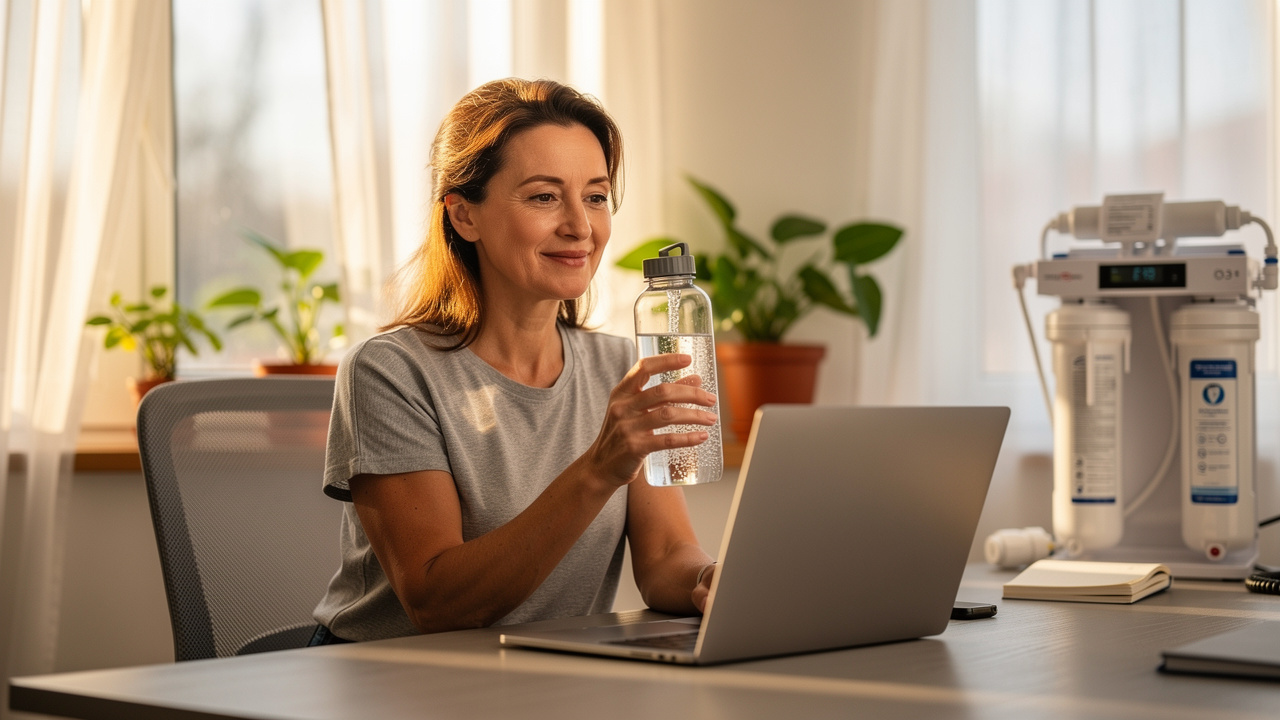
Bottom line: One of the few portable hydrogen bottles whose engineering actually addresses ozone safety. Worth the premium if you have filtered water access and will use it daily.
Pricing varies; check Amazon for current rates.
Echo Go+ Pros and Cons at a Glance
✓ Pros
✗ Cons
Specifications at a Glance
| Specification | Echo Go+ (manufacturer-reported) |
|---|---|
| Capacity | ~12 oz (~355 ml) |
| Hydrogen output (claimed) | Up to 2.5 PPM (5-min cycle), up to 4.5 PPM (10-min cycle) |
| Technology | SPE/PEM dual-chamber electrolysis |
| Electrode material | Platinum-coated titanium |
| Battery | Lithium-ion, USB-C charging (5V-2A only) |
| Material safety | BPA-free, food-grade construction |
| Warranty | Multi-year limited (verify current terms before purchase) |
| Acceptable water | RO, distilled, spring, or 99%+ chlorine-removal filtered only |
| Price | Check current price on Amazon |
The Echo Go+ Has Been Replaced by the Echo Flask
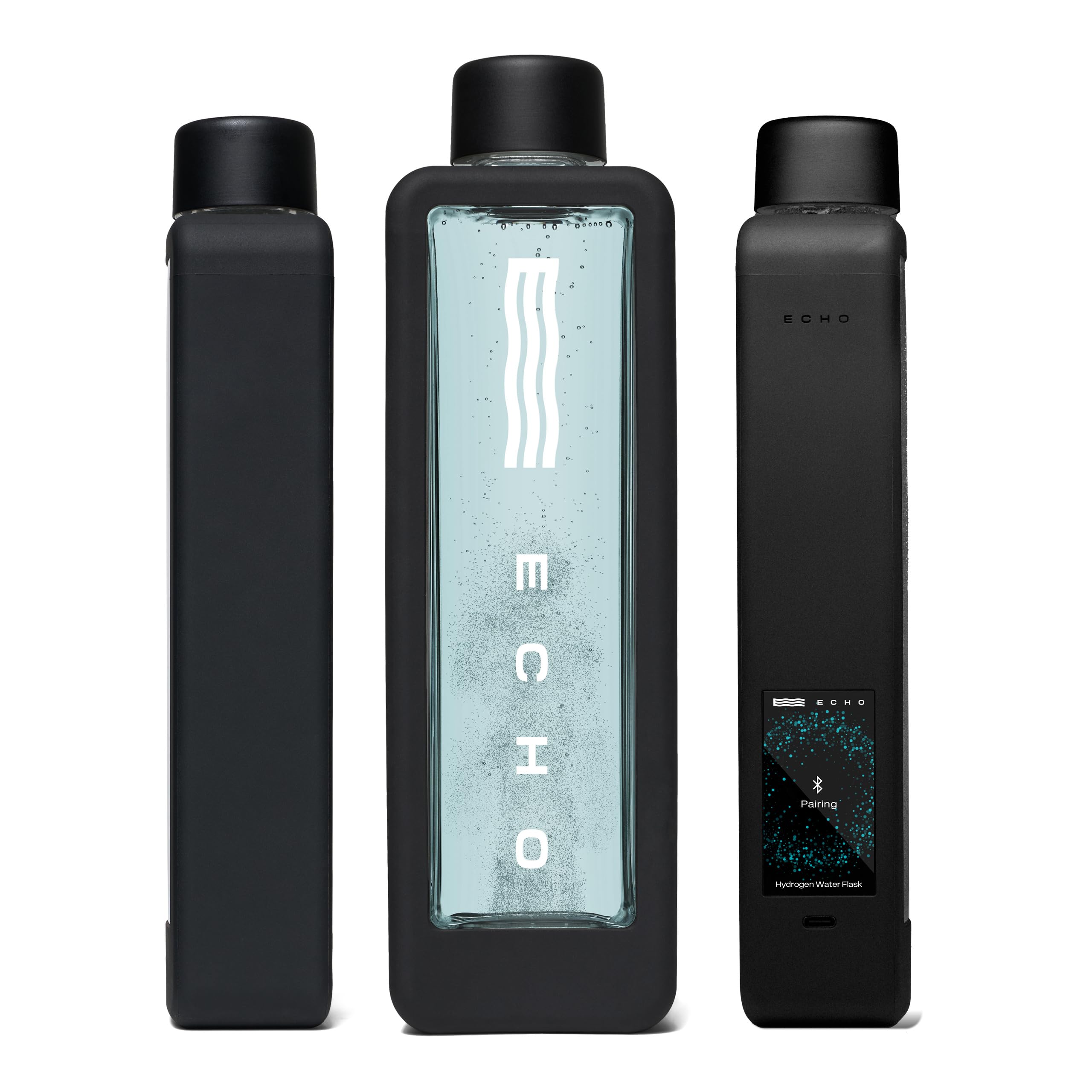
- Smart Water Bottle: With an LCD touch screen and smart connectivity features via the Echo App, the Echo Flask offers real-time hydration monitoring and water intake tracking to help you reach your hydration goals.
- Hydrogen Water Generator: This flask delivers an optimal hydrogen concentration of up to 8 ppm for hydrogen-rich water that supports cellular health and faster recovery with every sip*.
- Portable Hydrogen Flask: Designed for convenience, this compact water bottle offers an extended water capacity of 12 ounces (350 ml) for a seamless fit into your active lifestyle.
- Active Hydration Solution: From pure hydrogen production to adjustable hydrogen levels, the Echo Flask ensures high-quality water, helping you perform better, feel stronger, and think clearer each day.
- Hydrogen Therapy: Echo Water utilizes cutting-edge technology to maximize the health benefits of hydrogen water and gas, supporting enhanced vitality and longevity.

Echo Water has discontinued the Go+ and replaced it with the Echo Flask. The manufacturer’s own product listing now states that the Echo Go and Echo Go+ are the Echo Flask. If you are shopping today, the Go+ is the outgoing model — still findable through third-party sellers and clearance stock, but no longer the current bottle in Echo’s line.
That matters more than an ordinary refresh, because the two bottles are not specified alike. The Flask is positioned as the flagship: higher claimed hydrogen output, a larger chamber, a different housing material, and app connectivity the Go+ never had. Everything below this section still describes the Go+ accurately. Treat it as the reference for a bottle you may find discounted or second-hand, not as a recommendation to buy the current model.
One caution before you shop. At least two unrelated products use similar naming on marketplace listings — a “NuRich Echo NuRich Flask” from a different manufacturer, and an “Honest Hydrogen Flask” sold under a page title referencing the Echo. Neither is made by Echo Water. Check the brand and seller fields on the listing before ordering.
Echo Flask vs Echo Go+: What Actually Changed
The figures below are manufacturer-stated, taken from Echo Water’s own comparison documentation. Hydrogen Water Safety has not measured either bottle, and no number in this table was produced by us.
| Specification | Echo Go+ (outgoing) | Echo Flask (current) |
|---|---|---|
| Claimed hydrogen concentration | Up to 4.5 ppm | Up to 8 ppm |
| Capacity | 9.5 oz | 12 oz |
| Housing material | Polycarbonate | PPSU |
| App connectivity | None | Hydration tracking, cycle control |
| Display | Indicator lights | LCD touch screen |
| Price | Check current price on Amazon | Check current price on Amazon |
Echo’s own documentation puts Flask battery life at five to seven cycles of ten minutes, or three to four cycles of twenty minutes, per full charge. The company also notes that operating noise varies between units and that the variation does not indicate any difference in hydrogen output — a useful thing to know before assuming a quiet bottle is a faulty one.
The practical read: the Flask’s claimed advantage is concentration and capacity, and the same physical ceiling applies to both bottles. Dissolved hydrogen escapes an unpressurised container quickly, which is why the guidance for every device in this category is to drink promptly after a cycle rather than let the bottle stand. A higher generation figure does not automatically mean a higher figure in the water you actually swallow.
Why Published Echo Flask PPM Figures Don’t Agree
Published hydrogen figures for the Echo Flask range from roughly 1.6 ppm to 8 ppm depending on which source you read — close to a five-fold spread for a single product. That gap is worth understanding before you weigh any concentration claim, on this bottle or any other.
| Source type | Reported figure | Stated basis |
|---|---|---|
| Echo Water (manufacturer) | Up to 8 ppm | Product specification |
| Independent review site | 4.7–7.6 ppm | Self-reported reagent testing, protocol not published |
| Independent review site | Approximately 1.6 ppm | Self-reported comparison against the Echo Go, protocol not published |
Several things drive that spread, and none of them require anyone to be lying:
- Generation is not the same as dissolved concentration. A device can generate more hydrogen than the water is physically able to hold. The excess leaves as visible bubbling. Manufacturer figures typically describe production; what reaches you is lower.
- Timing changes the answer. Dissolved hydrogen begins escaping the moment the cycle ends. A reading taken immediately and a reading taken ten minutes later are measuring different things.
- Reagent titration has limited resolution. Drop-count methods return a value in steps, not a continuous reading, and the result depends on sample volume and on the person counting.
- Water source affects the reaction. Electrolysis efficiency varies with the mineral content of the starting water, so the same bottle can produce different results on filtered, distilled, and spring water.
- No published protocol means no comparability. When two reviewers do not state sample volume, timing, or reagent batch, their numbers cannot meaningfully be set against each other.
Our position is the one we apply across this site: we have not measured the Echo Flask, so we are not adding a seventh number to the pile. What we can tell you is that the published figures disagree by a factor of nearly five, that none of the independent ones come with a verifiable method, and that any bottle’s real-world concentration falls between the cycle ending and the moment you finish drinking. Treat a headline PPM number as a ceiling claim, not a serving size.
What Is the Echo Go+ and How Does It Actually Work?
The Echo Go+ is a portable hydrogen water generator that uses electrolysis to dissolve molecular hydrogen (H2) into drinking water. It sits in a category between generic Amazon bottles in the $50–$80 range and countertop hydrogen machines in the $400–$1,500 range. What separates it from cheap alternatives is the combination of its electrode materials and its dual-chamber design.
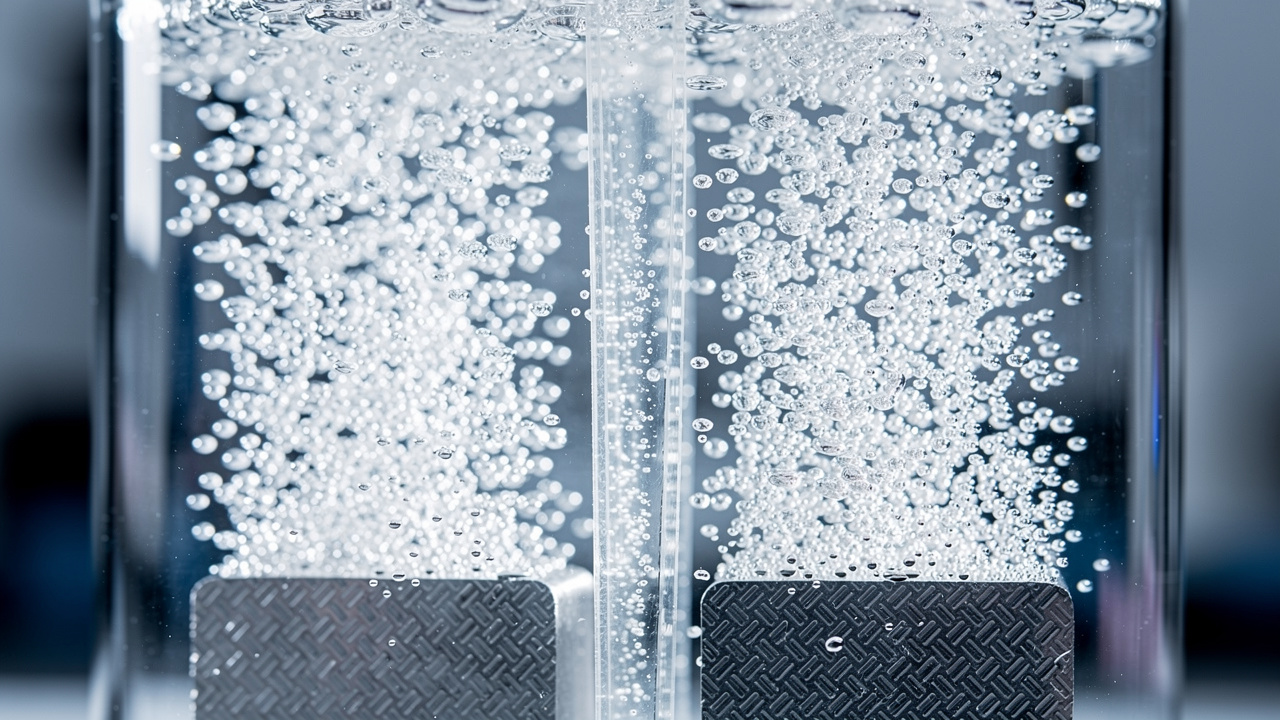
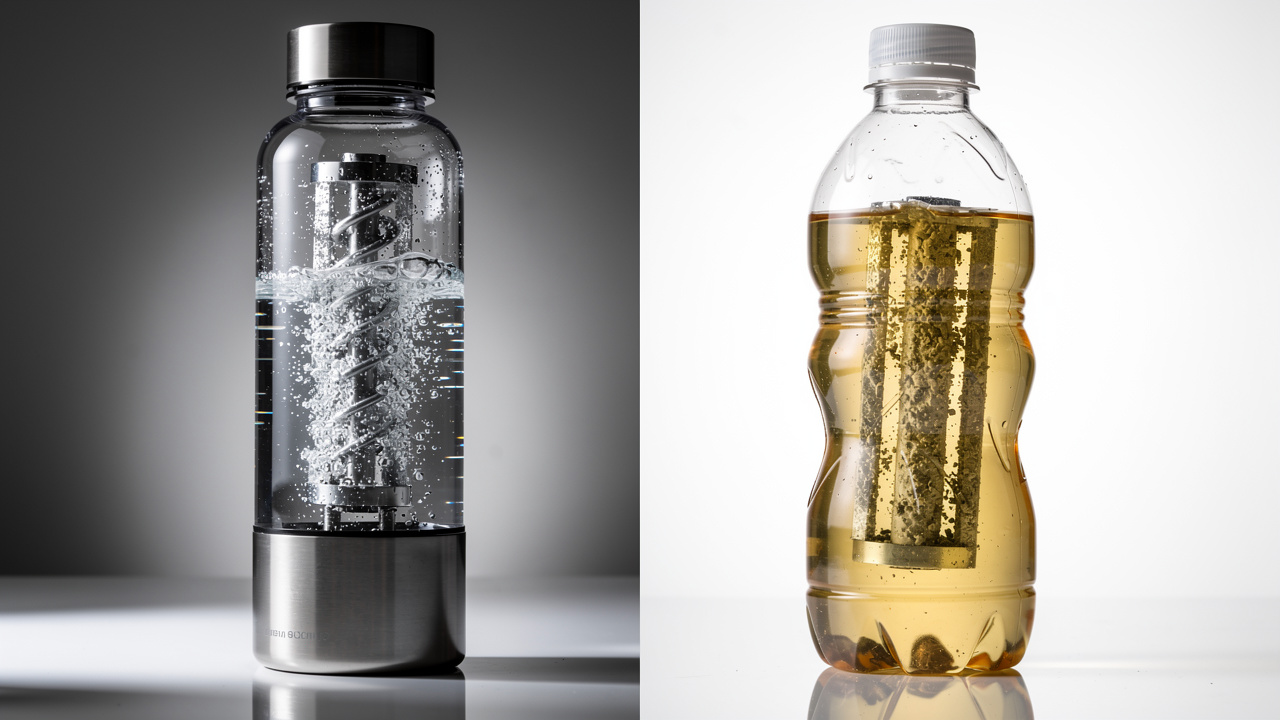
The technology centers on Solid Polymer Electrolysis (SPE) using a Proton Exchange Membrane (PEM). In a single-chamber bottle — which most generic Amazon listings use — electrolysis produces hydrogen and oxygen, ozone, and (if tap water is used) chlorine byproducts, and all of these dissolve into the water you drink. In a dual-chamber PEM design, the membrane is selective: hydrogen ions pass through into the drinking-water chamber, while oxygen, ozone, and chlorine byproducts remain trapped in the secondary chamber and exit through a dedicated expulsion port. This separation is the difference between a bottle that hydrates you and a bottle that exposes you to ozone — a respiratory irritant that should not be in drinking water at meaningful concentration.
Echo Tech publishes hydrogen concentration claims by cycle length, citing third-party gas chromatography testing. We have not independently verified those test results. Real-world output is sensitive to water quality, electrode condition, cycle length, and unit age. Verified-buyer reports describe noticeable bubble production and the characteristic faint metallic taste associated with dissolved hydrogen, but most buyers do not have access to a hydrogen meter and cannot independently confirm PPM. Treat marketed PPM peaks as ceiling claims under ideal conditions, not field averages.
How it differs from $50–$80 Amazon bottles: cheap alternatives typically use single-chamber electrolysis (no ozone separation), publish unverified PPM claims, use lower-grade electrode alloys that can leach metals as the coating wears, and offer one-year warranties at best. The Echo Go+ addresses these gaps through its PEM separation, manufacturer-cited third-party testing, and a longer warranty period.
Buyer Review Synthesis: What Real Users Actually Report
Methodology: This synthesis draws from verified-purchase reviews on Amazon and discussion threads on Reddit’s r/HydrogenWater community. Reviews flagged as obviously incentivized or inauthentic were excluded from pattern analysis. Themes are described qualitatively; we do not publish percentage breakdowns we have not statistically computed.
Common positive themes
- Hydration habit reinforcement: The ritual of running a cycle and waiting 5–10 minutes increases overall daily water intake — independent of any hydrogen-specific effect.
- Athletic recovery perception: Endurance athletes describe perceived faster recovery when consuming hydrogen water within roughly 30 minutes of training.
- Build quality: Buyers consistently rate materials, weight, and pressure-release feedback as feeling more premium than sub-$100 alternatives.
- Customer service responsiveness on warranty claims: When defects occur, the resolution path is generally described as functional.
Common negative themes
- Price objections: First-time buyers frequently regret not starting with a cheaper bottle to confirm whether they noticed any effect at all.
- Maintenance learning curve: Strict water-source rules + mandatory descaling + dry-membrane rehydration is friction users do not expect from a “bottle.”
- Bubble production decline: The most common longer-term complaint. In the majority of cases this is descaling-related, not electrode failure.
- Battery life over time: Buyers past the first year describe needing to charge more frequently — typical lithium-ion behavior, but worth knowing.
- Travel constraints: Lithium battery means TSA carry-on only; several reviewers describe shipping it home rather than risking checked baggage.
Realistic timeline for perceived effects: Buyers reporting subjective benefits (energy, recovery, mental clarity) generally describe a 3–8 week window before they were confident the effect was real. Immediate dramatic transformations are rare in the review corpus.

Decided the Echo Go+ is the right fit? Pricing varies between retailers and seasonal promotions.
Is the Echo Go+ Worth the Money?
Cost per day calculation (illustrative): If we assume a representative price point around $250 and a conservative 12-month lifespan. That is roughly $0.71 per day. Bottled hydrogen water pouches retail for $3–$5 per pouch. If you would otherwise drink one pouch per day, the Echo Go+ pays for itself in 50–90 days. If you drink hydrogen water 1–2 times per week, you will not recover the investment versus simply buying pouches occasionally.
What the premium actually buys: Three things. First, dual-chamber PEM separation, which is the only meaningful safety feature in this product category and is absent from most sub-$100 bottles. Second, platinum-coated titanium electrodes, which resist corrosion better than lower-grade alloys. Third, a longer warranty window than the 1-year industry default. Verify current warranty terms on the manufacturer’s listing before purchase.
When cheaper bottles are the right call: If you are testing whether hydrogen water has any noticeable effect on you at all, you do not need the Echo Go+ to find out. A $100–$150 bottle from a brand with at least minimal third-party validation is enough to settle the question. If after 30–60 days of daily use you genuinely feel a difference, the upgrade is justified. If you do not feel a difference, you have saved $150.
Echo Go+ Safety Verification: The Ozone Question
Ozone (O3) is the primary safety hazard in hydrogen water bottles. Electrolysis splits water molecules into hydrogen and oxygen. If the oxygen path is not properly isolated, oxygen radicals can recombine into ozone, and that ozone can dissolve into the same water you are about to drink. Ozone is a respiratory and mucous-membrane irritant; it is not something you want at meaningful concentration in a beverage.
The Echo Go+ addresses this through its PEM dual-chamber design (manufacturer-disclosed). The Proton Exchange Membrane is selective: hydrogen ions transit the membrane into the drinking-water chamber, while oxygen and ozone byproducts stay in the secondary chamber and exit through a dedicated oxygen expulsion port. During a cycle you can see small bubbles escaping from this port — visible evidence that the byproduct gases are being vented rather than dissolved.
Echo Tech cites third-party laboratory testing reporting non-detectable ozone concentration in the drinking-water output. This is manufacturer-supplied data; we have not independently verified the test results. The structural argument for safety is the dual-chamber design itself, which is a recognized engineering approach to this problem and is genuinely missing from most sub-$100 bottles. Read our deeper write-up on ozone risk in hydrogen water bottles.
Tap water prohibition is not optional. Chlorine in tap water reacts with electrolysis to produce chlorine gas and hypochlorous acid, both of which corrode platinum electrodes and harm respiratory tissue. Use only reverse osmosis, distilled, spring, or properly filtered water (a filter rated for 99%+ chlorine removal — standard pitcher filters do not meet this bar). Using tap water voids the warranty and destroys hydrogen production capacity, often within a small number of cycles.
FDA context: Hydrogen gas holds GRAS (Generally Recognized as Safe) status under 21 CFR 184.1366 for use in food packaging and food processing applications. This is a regulatory category about industrial hydrogen use, not an FDA approval of hydrogen water bottles as medical devices or hydrogen water as a therapeutic beverage. No hydrogen water bottle on the consumer market is “FDA-approved.” Manufacturers who imply otherwise are misrepresenting the regulatory landscape.
How to Clean the Echo Go+: Maintenance Reality Check
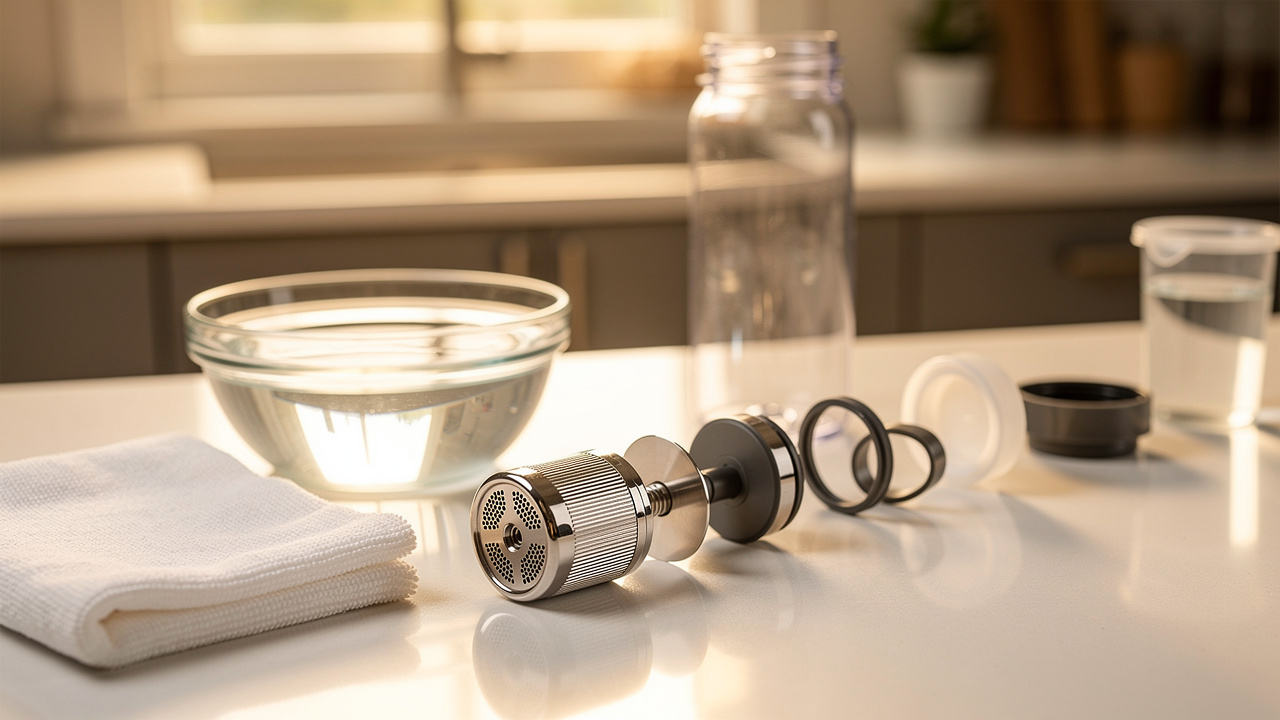
Daily: Leave roughly one tablespoon of water in the generator base when not in use. This keeps the PEM membrane hydrated. A fully dry membrane loses ion conductivity and stops producing hydrogen until rehydrated through a “shock” cycle.
Weekly: Hand-wash the bottle and lid with warm water and mild non-abrasive detergent. Do not use a dishwasher: heat warps the silicone seals and harsh detergents corrode the electrode coating.
Descaling schedule by water type:
| Water source | Descaling frequency |
|---|---|
| Reverse osmosis or distilled | Once per month |
| Spring or filtered (low TDS) | Every two weeks |
| Mineral-rich filtered (TDS > 150 ppm) | Weekly |
- Mix one part white vinegar (5% acidity) with three parts filtered water
- Pour the solution into the generator base until it covers the electrodes
- Let it soak for 2–3 hours (overnight if you can see heavy white scaling)
- Pour out the vinegar solution
- Rinse the base 3–4 times with fresh filtered water
- Run one short cycle with clean water and discard that flush water before drinking
Membrane rehydration (“shock” cycle): If stored empty for more than 48 hours, the PEM may be dry. Fill with hot (around 140–160°F) filtered water, run an extended cycle, and the heat plus electrolysis rehydrate the membrane’s ion channels.
Time investment: About 5 minutes weekly + roughly 15 minutes monthly. Annualized, ~4–5 hours per year on maintenance.
Echo Go+ vs Cheaper and Mid-Tier Alternatives
| Feature | Generic tier | Mid-tier | Echo Go+ |
|---|---|---|---|
| Third-party PPM testing | Typically none | Sometimes | Manufacturer-cited |
| Ozone separation | Single-chamber (mixes byproducts) | Varies | Dual-chamber PEM |
| Electrode material | Lower-grade alloy | Mixed quality | Platinum-coated titanium |
| Warranty | ~1 year | 1–2 years | Multi-year (verify terms) |
| Best for | Trying hydrogen water once | Casual regular use | Daily committed use |
For a side-by-side comparison across the full bottle category, see our independent hydrogen water bottle roundup.
Who Should Buy the Echo Go+ (And Who Shouldn’t)
Best-fit buyers
- Daily hydrogen water consumers running at least one cycle per day
- Athletes prioritizing post-workout recovery and oxidative stress management
- Households with reverse osmosis, distilled, or properly filtered water access
- Buyers who specifically value third-party PPM verification over unverified marketing claims
- Users willing to commit ~10 minutes per week to maintenance
- Health-conscious consumers who want to avoid the ozone exposure associated with single-chamber generic bottles
Wrong-fit buyers
- First-time hydrogen water experimenters — start cheaper, confirm any subjective effect, then upgrade if it matters
- Tap-water-only households without 99%+ chlorine-removal filtration
- Anyone wanting Keurig-level zero-effort appliance behavior
- Budget-constrained buyers for whom $250+ creates real financial strain
- Frequent travelers needing TSA-checked-bag-friendly hardware
- Buyers expecting dramatic 24-hour transformations — realistic timelines are weeks, not days
Alternatives
- Budget-conscious buyers: See our independent roundup of hydrogen water bottles for picks across price tiers.
- First-time tryers: Buy any quality bottle with a 30–60 day return policy, use it daily for 30 days, then decide whether to upgrade.
- Safety-first readers: Before buying any bottle, read why ozone separation is the single most important feature.
Check Echo Go+ Price on Amazon →
Frequently Asked Questions
Final Verdict: Is the Echo Go+ Right for You?
The Echo Go+ is one of the few portable hydrogen bottles whose engineering actually addresses the two material risks in this category — unverified hydrogen output and ozone contamination — rather than ignoring them. Its dual-chamber PEM separation is genuine differentiation versus sub-$100 generics. The premium price buys real safety architecture, not just marketing.
It is not a bottle for everyone. If you do not have access to filtered water, the device will fail prematurely. If you will not commit to weekly maintenance, hydrogen output will degrade quickly. If you are testing whether hydrogen water has any noticeable effect on you at all, you are buying the wrong product first — start cheaper, confirm there is something to feel, then upgrade. If you are a daily user with the right water access, the Echo Go+ is one of the most defensible choices in the category at this price point.
This is a research-based evaluation. We have not personally lab-tested the Echo Go+ unit. All performance figures are manufacturer-reported or derived from manufacturer-cited third-party testing.
Ready to buy?
Check current pricing and availability on Amazon. Prices vary with retailer promotions.
For category context, see our independent hydrogen water bottle roundup and our full evaluation methodology.
Last update on 2026-09-15 / Affiliate links / Images from Amazon Product Advertising API
This product presentation was made with AAWP plugin.