How to Test Hydrogen Water: Methods, Meters and Limits
Sources checked November 8, 2026. Research-based guidance. HWS has not performed the tests or heating experiments described here. Read how we evaluate evidence.
How can you test hydrogen water?
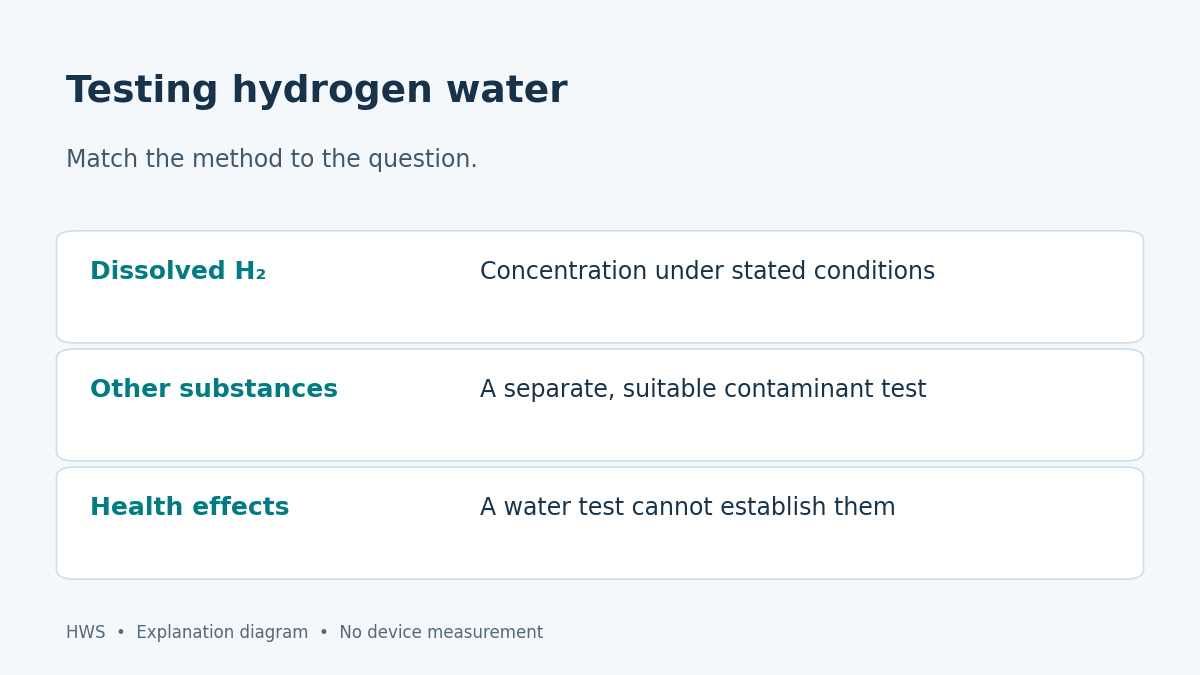
Choose a method intended to measure dissolved molecular hydrogen, follow its exact instructions, and record the conditions. A negative ORP number, visible bubbles or a seller’s PPM display cannot substitute for that record. A home estimate also cannot establish that water is free of contaminants or that drinking it will produce a health benefit.
Start by deciding what you need to know. Comparing your bottle’s cycles is a different task from checking a retailer’s advertised peak, investigating a contaminant, or evaluating a health claim. Use the smallest test that can answer your actual question, and keep its limitations with the result.
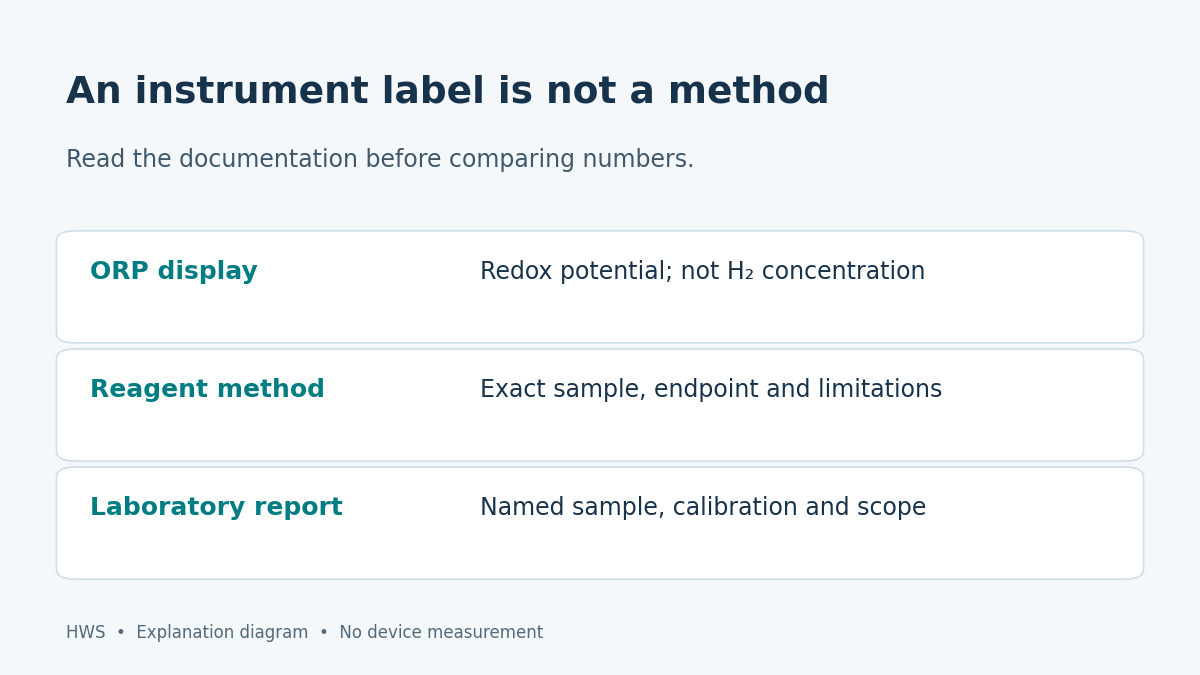
Read the method behind the meter
An ORP instrument measures oxidation–reduction potential. A 2022 theoretical analysis and narrative review explains why pH, temperature and other redox-active substances prevent a simple ORP-to-H₂ conversion from reliably comparing ordinary samples. A display labeled “hydrogen” is therefore not enough: check whether the instrument actually senses H₂ or calculates a value from ORP.
That paper is not an independent test of every retail meter. One coauthor disclosed leadership roles with the H2Blue manufacturer and H₂ Analytics. Its discussion supports scrutiny of the measurement method; it does not certify a particular kit, bottle or clinical outcome.
A reagent example: H2Blue
The H2Blue vendor’s standard instructions use a 6 mL sample, count the drop that leaves the sample persistently blue, and apply a 0.1 mg/L-per-drop conversion. These conditions belong together. Confirm your exact kit’s instructions, sample handling and interference limits rather than transferring that conversion to another volume or reagent.
Do not treat a colored endpoint as an all-purpose safety verdict. If you need to investigate ozone, metals or another substance, identify a test intended for that substance and sample type. The hydrogen estimate answers a narrower question.
Record enough detail to compare results
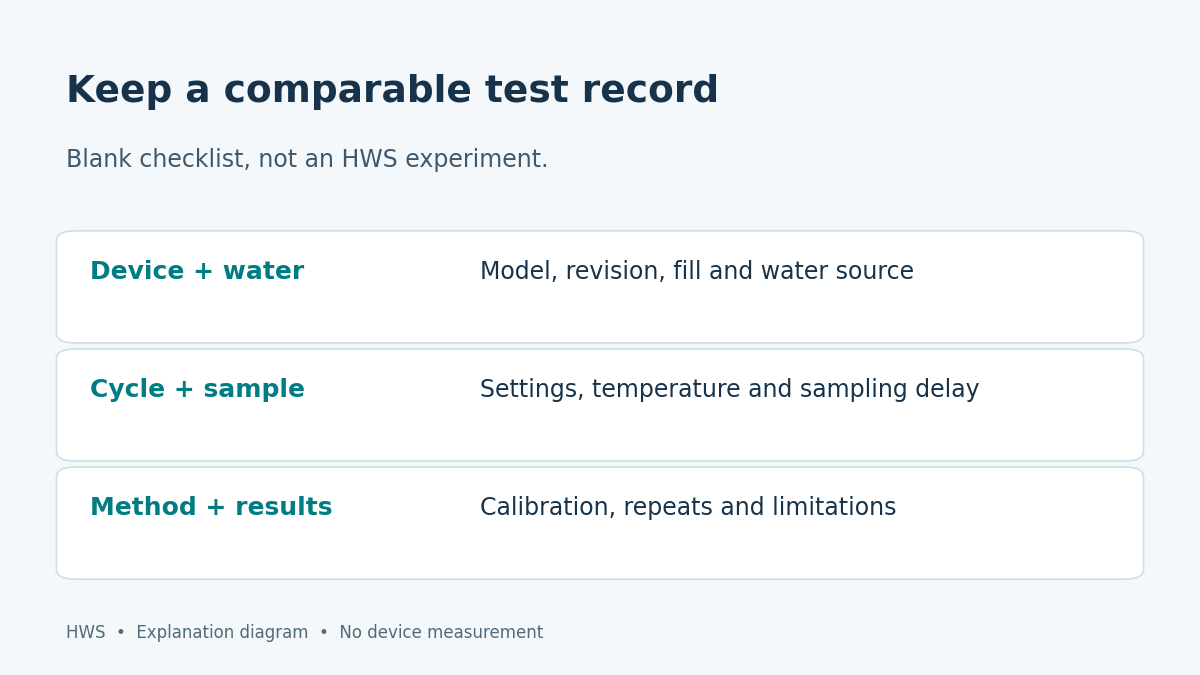
- Identify the exact model, revision and permitted source water. Record fill volume and the cycle you actually used.
- Record temperature and the delay between cycle completion, sampling and measurement. Do not compare a fresh result with an old sample as if conditions were identical.
- Identify the instrument or reagent, its current instructions, calibration information and stated limitations.
- Keep each repeat result rather than reporting only the highest value. Explain changed conditions instead of labeling an arbitrary percentage difference a defect.
- Attach units to every result. For dilute water, 1 mg/L is approximately 1 ppm, and 1 ppm equals 1,000 ppb. Concentration is different from the total amount in a serving.
When is a laboratory report useful?
A useful report identifies the submitted sample and method, calibration or quality controls, sampling conditions, results and limitations. Ask whether it addresses hydrogen in water, gas above the water, or a different analyte. Match its sample or model to the item being advertised. A report for one sample does not establish every retail unit’s output or lifetime performance.
Our Hydroh report review illustrates why those conditions matter. It compares a seller’s claims with the actual report rather than treating the presence of a laboratory logo as blanket verification.
Questions before buying a testing tool
- What does the instrument directly measure?
- What calibration and maintenance does it require?
- Which sample types and interfering substances are excluded?
- Can you document the sampling delay and temperature?
- Would a qualified laboratory be more appropriate for the question?
Does a high result prove a health benefit?
No. A concentration measurement describes a sample under particular conditions. It does not establish a medical effect, a suitable personal dose, product-wide safety or the quality of the manufacturer’s health evidence.
Can bubbles confirm the amount of dissolved H₂?
Visible bubbles are an observation, not a calibrated concentration measurement. Use the documented method and its limitations. See how hydrogen-water bottles work for the device context.
Some linked HWS buying guides contain affiliate links. See our affiliate disclosure. This explanation is not a product test or a medical recommendation.