
How Long Does Hydrogen Water Last? Storage & Retention Guide
Generate a bottle of hydrogen water in the morning, leave it on your desk, and drink it at lunch — and you may be drinking plain water. Molecular hydrogen (H₂) starts escaping the instant it is dissolved, so “how long does hydrogen water last” is really a question about how long it is still doing anything.
Hydrogen water begins losing dissolved H₂ the moment it is exposed to air. In an open glass, most is gone within about 30 minutes to 2 hours. Sealed in a non-porous container it can hold useful levels for several hours; refrigerated and airtight, up to roughly 6–12 hours. On-demand bottles are strongest at the moment of generation. There is no single fixed half-life — your container is the biggest factor.
Hydrogen water does not spoil or become unsafe; it simply loses the dissolved hydrogen that is the entire reason you are drinking it, reverting to ordinary water. This guide covers why H₂ escapes so fast, realistic retention windows by container type, how temperature and handling change them, and when to drink for the most benefit. The figures here are general estimates from water chemistry and commonly-cited ranges, not measurements taken by Hydrogen Water Safety.
Key Takeaways
- Hydrogen water is most potent immediately after generation — aim to drink within 10–15 minutes of opening a sealed container.
- Container material is the single biggest variable: borosilicate glass and stainless steel far outperform plastic.
- Cold slows H₂ loss; heat and boiling drive dissolved hydrogen out completely.
- Agitation — shaking, stirring, tipping — forces dissolved gas to the surface and speeds loss.
- Starting concentration matters: a low-output device leaves little to preserve no matter how you store it.
Why Hydrogen Gas Escapes From Water So Quickly
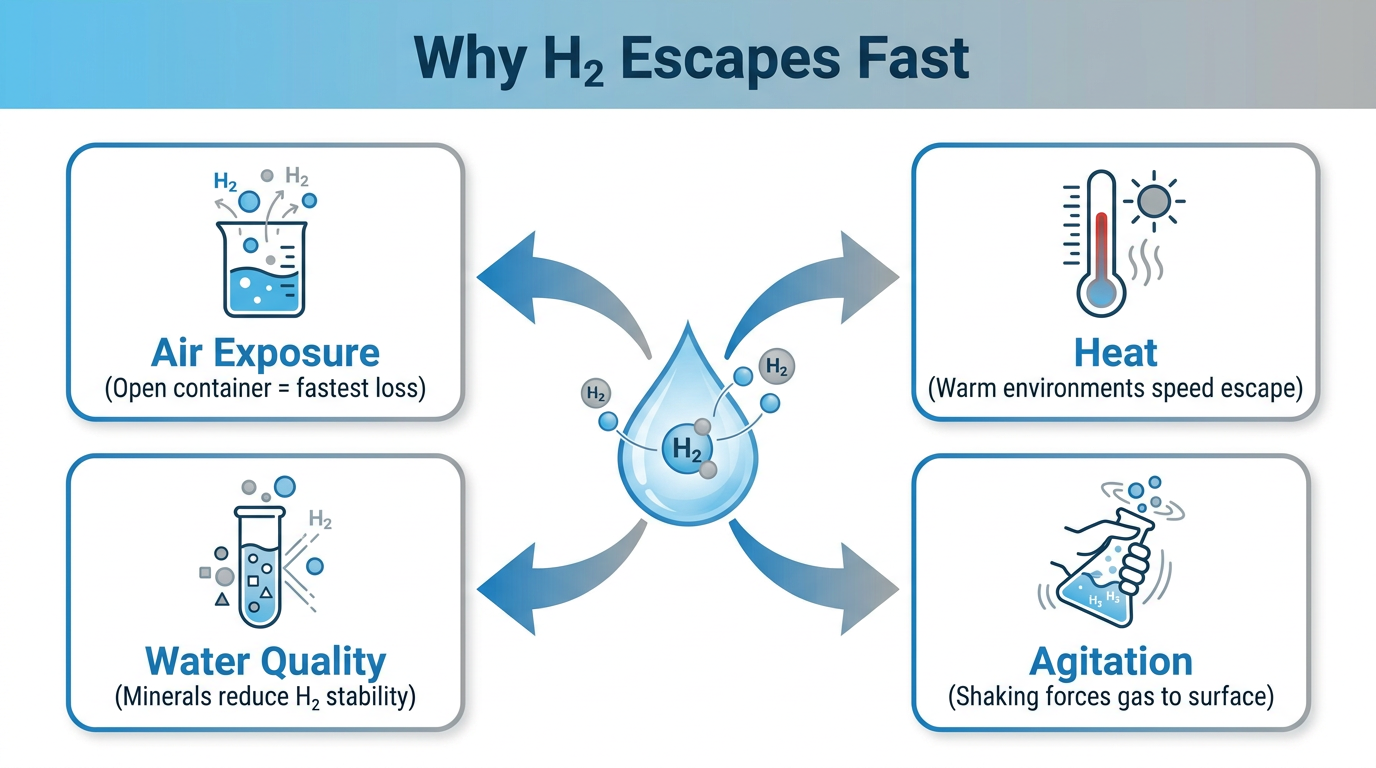
Molecular hydrogen (H₂) is the smallest and lightest molecule that exists. That physical reality has an inconvenient consequence for anyone drinking hydrogen water: H₂ does not stay dissolved for long. The moment hydrogen is infused into water — whether through SPE/PEM electrolysis, a hydrogen tablet, or a pre-packaged pouch — it begins seeking equilibrium with its surroundings.
The driving force behind this escape is a concentration gradient. The atmosphere contains essentially zero dissolved hydrogen, so the pressure differential between the hydrogen-saturated water and the surrounding air is extreme. H₂ molecules continuously migrate outward through the liquid surface, through cap gaps, and — critically — through the walls of certain container materials. The process never stops; it only slows under better conditions.
Several factors speed dissipation beyond that baseline gradient:
- Air exposure drives the fastest losses — once the container is open, hydrogen takes the direct path to the atmosphere.
- Heat raises the kinetic energy of dissolved gas, so a warm car, sunlit desk, or warm kitchen measurably shortens retention.
- Agitation from shaking, stirring, or repeated tipping forces dissolved gas to the surface — the same reason a shaken soda goes flat faster.
- Water quality matters too. High-mineral, high-chlorine tap water interferes with hydrogen stability; purified or reverse osmosis water holds dissolved H₂ more effectively.
How Container Material Affects Hydrogen Permeation
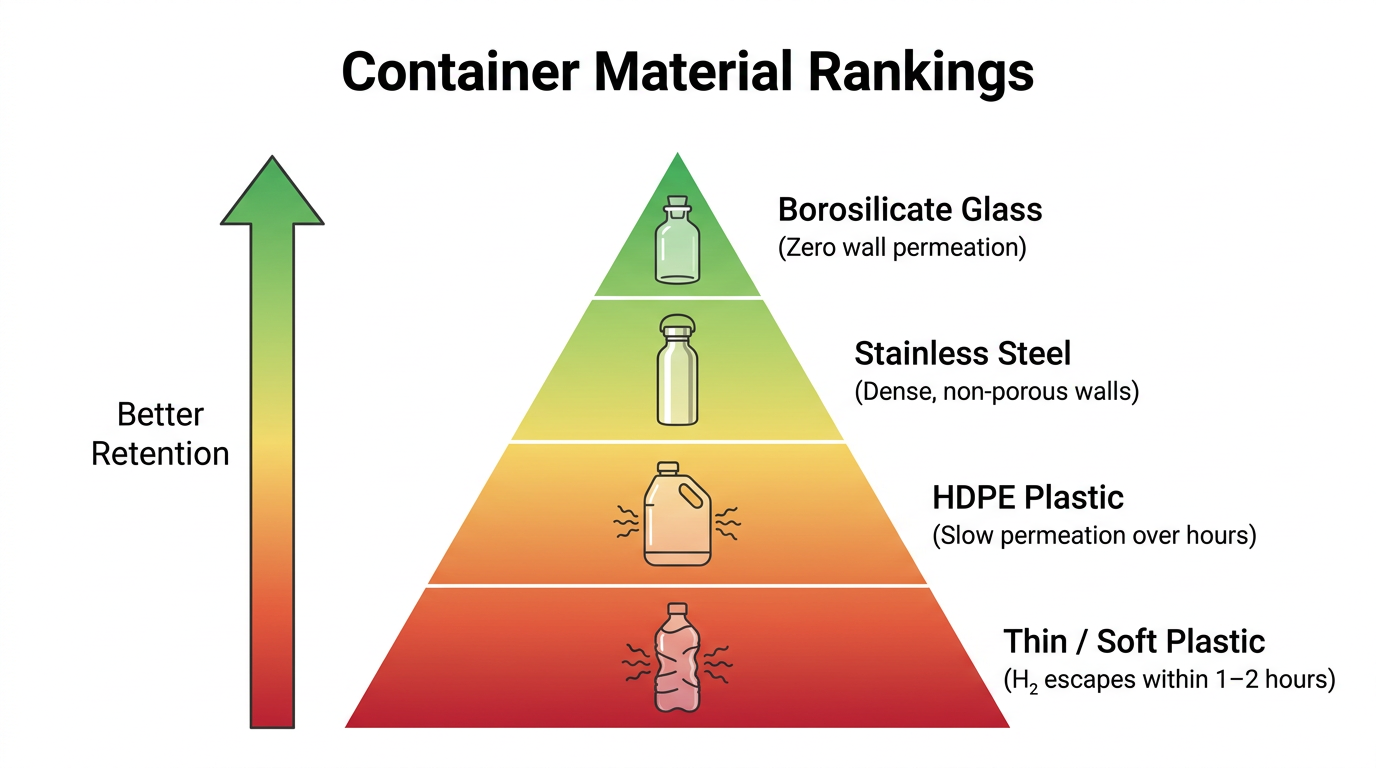
Container material is the most controllable variable in hydrogen retention, because materials differ widely in how much H₂ passes through the walls themselves — independent of the cap seal. Borosilicate glass and stainless steel are the gold standard: dense and non-porous, they allow near-zero permeation through the walls, so retention is limited only by seal quality. HDPE (high-density polyethylene) sits in the middle, permitting slow permeation over several hours. Thin or soft plastic, including BPA-free Tritan, has the highest permeation rate of all — hydrogen escapes through the walls within about 1–2 hours even with the bottle fully sealed. The practical hierarchy: Glass ≈ Stainless Steel > HDPE > Thin Plastic.
How Long Does Hydrogen Water Last by Container?
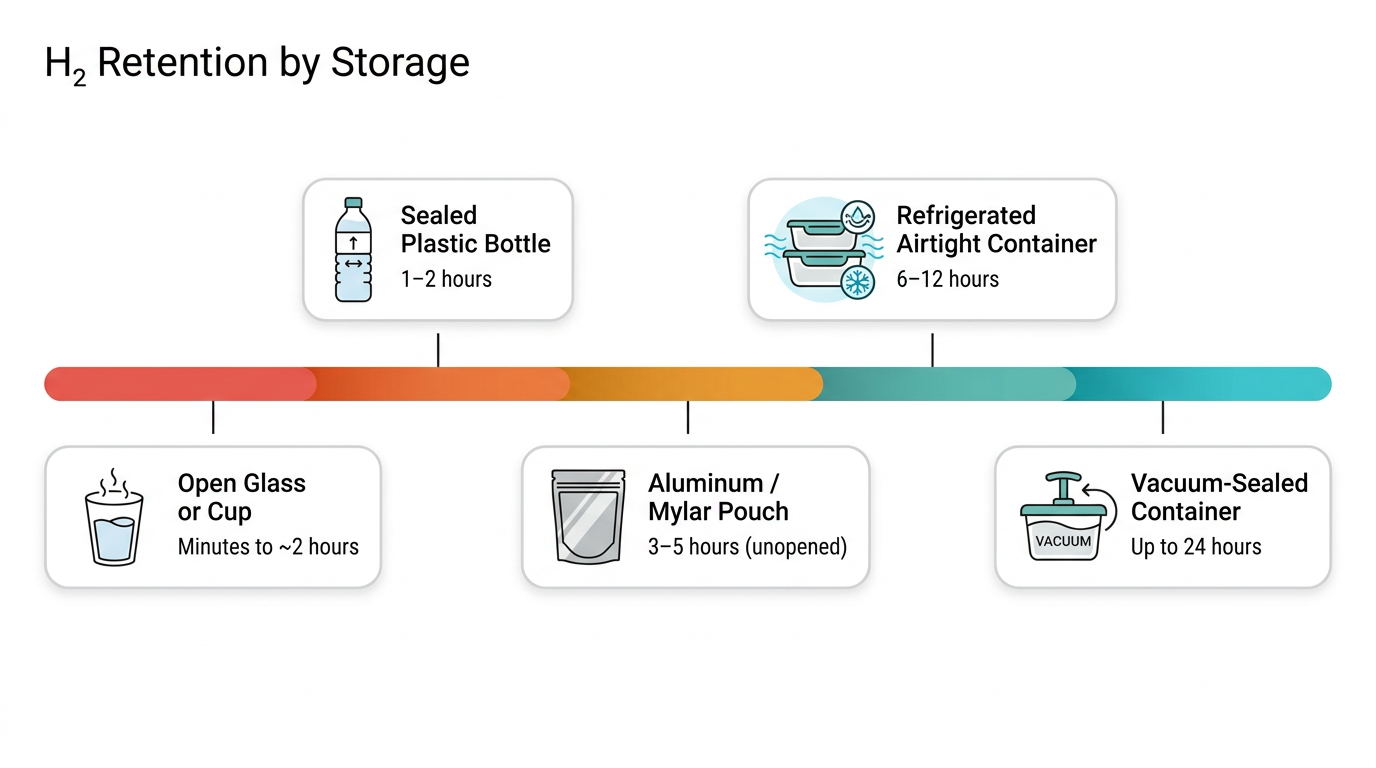
How long hydrogen water lasts in a bottle depends almost entirely on the bottle’s material and seal. The range runs from minutes in an open cup to as long as a day in a vacuum-sealed vessel. These are general estimates commonly cited across the hydrogen-water field, not Hydrogen Water Safety lab data — actual retention varies by device, seal quality, temperature, and starting concentration.
| Storage Condition | Estimated H₂ Retention |
|---|---|
| Open glass or cup | Minutes to ~2 hours |
| Sealed plastic bottle | ~1–2 hours |
| Sealed aluminum/Mylar pouch (unopened) | Several hours (commonly cited 3–5) |
| Aluminum/Mylar pouch, after opening | ~10–15 minutes |
| Insulated airtight bottle (opened periodically) | ~3–5 hours (strongest in the first 2) |
| Refrigerated, high-quality airtight container | ~6–12 hours |
| Vacuum-sealed airtight container | Up to ~24 hours (manufacturer claim) |
| Sealed, never-opened airtight container | Manufacturers claim up to ~2 weeks — treat cautiously |
| On-demand SPE/PEM bottle | Strongest at the moment of generation |
The two-week figure is a best-case ceiling under perfectly undisturbed conditions, not a practical guideline. For almost everyone, drink within 30 minutes to 2 hours for meaningful concentration; 6–12 hours is the outer limit for a well-sealed, refrigerated container. The Molecular Hydrogen Institute cites roughly 1.0 to 1.6 ppm as the concentration range used in research; once dissolved H₂ falls well below that, there is little left to matter.
On-demand SPE/PEM hydrogen water bottles are the most practical option for daily use: because they generate fresh H₂ at the point of consumption, the storage window becomes nearly irrelevant — you generate, you drink.
How Temperature, Boiling, and Handling Change Retention
Temperature is one of the most actionable variables. Cold slows the movement of dissolved gas molecules, measurably reducing the rate at which H₂ reaches the surface. Refrigerating sealed hydrogen water extends retention to roughly 6–12 hours in a quality airtight container — a clear improvement over room temperature.
Freezing is more nuanced. While very cold temperatures would slow dissipation further in theory, the freeze-thaw cycle introduces agitation and volumetric expansion that can compromise the seal and accelerate gas loss on thawing. For practical purposes, refrigeration is the reliable cold-storage method; freezing is not a retention strategy.
Boiling is the opposite extreme, and the outcome is absolute. Dissolved gases follow Henry’s Law: the warmer the water, the less gas it can hold. At a rolling boil, dissolved gases are driven out of solution almost entirely, so boiling hydrogen water leaves plain hot water with no dissolved H₂. Never heat hydrogen water to try to preserve it.
How Agitation and Movement Accelerate Hydrogen Loss
Physical disturbance is a significant and commonly overlooked source of loss. Shaking, stirring, swirling, or repeatedly tilting a bottle forces dissolved gas toward the surface, where it escapes almost instantly — the same mechanism as shaking a carbonated drink. Even tilting a bottle several times during a commute can produce measurable loss before your first sip. The practical rule is simple: handle hydrogen water gently, generate it close to where you will drink it, and consume it in place when you can.
How to Maximize Hydrogen Retention and When to Drink It
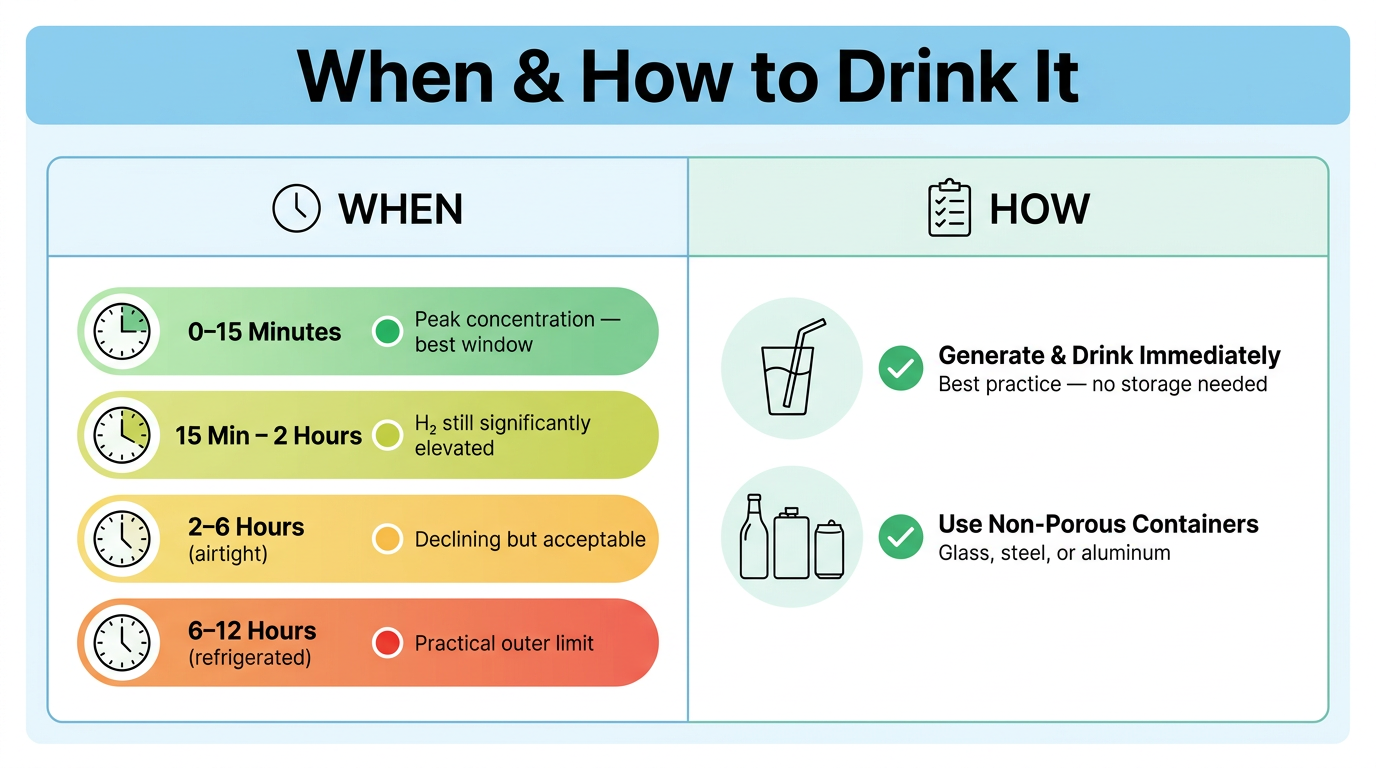
Knowing when to drink hydrogen water matters as much as how you store it. From optimal to acceptable:
- 0–15 minutes after generation — highest possible concentration; always the best window.
- 15 minutes to 2 hours — H₂ still meaningfully elevated; the recommended window for real benefit.
- 2–6 hours (sealed, airtight) — concentration has declined but may remain useful in a quality container.
- 6–12 hours (refrigerated, airtight) — the practical outer limit; diminishing returns beyond this.
- Beyond 12 hours — meaningful H₂ is unlikely under most real-world storage.
Beyond timing, these practices make a measurable difference:
- Generate and drink immediately whenever possible — no storage method beats fresh generation.
- Never transfer to a second container — pouring combines air exposure and agitation at once.
- Use non-porous containers — borosilicate glass, stainless steel, or sealed aluminum.
- Refrigerate stored hydrogen water to slow molecular escape.
- Minimize openings — each one releases H₂.
- Start with clean source water for efficient electrolysis and better retention.
- Choose an on-demand SPE/PEM bottle to remove the storage problem entirely.
One variable gets overlooked: starting concentration. A device that cannot reach roughly 0.5–1.6 ppm at generation leaves nothing meaningful to preserve, however well you store it. Our independent hydrogen water bottle reviews assess output based on specifications and verified-buyer reports — so you can gauge whether a bottle delivers adequate concentration before worrying about how long it lasts.
The Bottom Line
Hydrogen water does not go bad in any food-safety sense — it simply loses its dissolved H₂ and reverts to plain water. The issue is effectiveness, not safety. Drink within about 30 minutes of generation for the most benefit. If that is not possible, store it in an airtight, non-porous container and refrigerate — and never boil it, shake it, or pour it between vessels.
Starting concentration matters as much as storage: if your device is not producing hydrogen at a meaningful level to begin with, careful storage will not save it. For device-by-device output context, see our on-demand hydrogen water generator comparison.
Retention is one reason tablets keep coming up in buyer reports: they release hydrogen in the glass at the moment you drink, so storage time is not a factor. See the highest ppm hydrogen water tablets compared on label claims and buyer reports.
Frequently Asked Questions
Does hydrogen water expire or go bad?
Hydrogen water does not spoil or become unsafe to drink. “Expiration” here means loss of functional potency, not a food-safety risk. Once the dissolved H₂ escapes, you are left with regular water — perfectly safe, but without the antioxidant properties you were after.
Can you store hydrogen water in the fridge overnight?
Yes, in a high-quality airtight, non-porous container. Refrigeration extends meaningful H₂ retention to roughly 6–12 hours. Beyond about 12 hours, even under ideal conditions, dissolved hydrogen will have declined to negligible levels in most practical setups.
Does shaking a hydrogen water bottle reduce its effectiveness?
Yes. Agitation forces dissolved H₂ toward the surface, where it escapes quickly. Avoid shaking, stirring, or repeatedly tipping the bottle before drinking; generate as close to your point of consumption as possible and handle the container gently.
Is hydrogen water from a plastic bottle safe to drink?
It is generally safe if the plastic is food-grade and BPA-free. But thin, soft plastics have the highest permeation rate — H₂ passes through the walls within about 1–2 hours even when sealed. Safety is not the concern with plastic; effectiveness is. Glass or stainless steel is far better for retention.
How can I tell if my hydrogen water still has H₂ in it?
There is no reliable visual or taste indicator. Tiny bubbles right after electrolysis suggest H₂ is present, but their absence does not confirm full depletion and their presence does not confirm adequate concentration. The only accurate method is a dissolved-hydrogen (H₂) meter that reads parts per million directly.
Compare your options
Independent comparisons of hydrogen water products, ranked on published specifications and certifications rather than marketing claims:
- Best hydrogen water tablets — device-free, nothing to maintain
- Best hydrogen water bottles — portable SPE/PEM generators
- Best hydrogen water generators — countertop and higher-output machines
- Best hydrogen water pitchers — larger volume for household use