
Disclosure & evidence. As an Amazon Associate, Hydrogen Water Safety earns from qualifying purchases — at no extra cost to you, and with no influence on our picks. No sponsored placements. Evidence position: manufacturer specification audit, third-party certification review, and verified-buyer synthesis. We own neither of these units and have lab-tested neither. Testing protocol · Full disclosure.
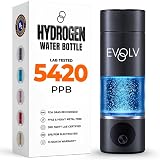
EVOLV Hydrogen Water Bottle
5.4 PPM claimed · 8 oz · 5 & 10-min cycles
- Dual-lab certification cited by the manufacturer — H2 Analytics and H2HUBB, gas chromatography
- SGS heavy-metal leaching testing cited by the manufacturer
- Membrane grade disclosed (Nafion N115)
- Higher claimed output of the two
- Electrode coating not disclosed
- Smaller capacity — 8 oz
Buy if published third-party documentation is your deciding factor.

Echo Go+ Hydrogen Water Bottle
~4.5 PPM claimed · 10 oz · 5 & 10-min cycles
- Two more ounces per cycle — 10 oz
- Electrode material named: platinum-coated titanium
- Decade-plus brand track record
- 5-year limited warranty
- Lower claimed output — 4.5 vs 5.4 PPM
- Warranty is prorated store credit; battery not covered
Buy if capacity and electrode disclosure matter more.
Product images and titles sourced live from Amazon. Prices change — tap through for the current listing.
There is no single winner — and most comparisons online get this backwards.
The correction that matters: many reviews credit the Echo Go+ with 8,100 PPB. It does not produce that. 8,100 PPB is a different product’s figure. Echo Go+ is rated to roughly 4.5 PPM — below EVOLV’s 5.4 PPM claim, not above it.
And neither number is what you drink. At ordinary pressure, water holds roughly 1.6 mg/L of dissolved hydrogen at equilibrium; higher figures describe a transient peak that falls as hydrogen escapes. HWS has not measured what either bottle delivers. Choose on capacity, documentation, and warranty terms — the things that genuinely differ.
Safety note. Hydrogen water bottles are wellness products, not medical devices. They do not diagnose, treat, cure, or prevent any disease. If you have kidney disease, are pregnant, are nursing, or take prescription medication, talk to your doctor first. See our medical disclaimer.
EVOLV vs Echo Go+: Side-by-Side Specifications
All figures below are manufacturer-reported or third-party-certified, pulled from current listings and published documentation. Hydrogen Water Safety has measured neither unit. Confirm the current spec sheet on the listing before ordering — both brands sell multiple variants.
| Specification | EVOLV | Echo Go+ |
|---|---|---|
| Claimed max output | 5.4 PPM (5,400 PPB), 10-min cycle | ~4.5 PPM, 10-min cycle |
| Short cycle | 5 min → 2.5 PPM stated | 5 min → 2–3 PPM stated |
| Capacity | 8 oz (240 ml) | 10 oz (300 ml) |
| Membrane | Japanese SPE/PEM, Nafion N115 — grade disclosed | SPE/PEM, grade not specified |
| Electrode material | Not disclosed | Platinum-coated titanium — disclosed |
| Third-party output certification | H2 Analytics + H2HUBB, gas chromatography | H2 Analytics cited across product line |
| Materials testing | SGS heavy-metal leaching testing cited by the manufacturer | Not specified for this model |
| Body material | German food-grade polycarbonate, BPA-free | Food-grade polycarbonate, BPA-free |
| Waste-gas handling | Built-in exhaust valve (chlorine + ozone) | SPE/PEM separation |
| Warranty | Not clearly stated; 5+ yr lifespan claimed | 5-year limited, prorated store credit — battery not covered |
| Charging | Magnetic USB | Rechargeable, ~8–10 cycles/charge |
The Output Claims: 5.4 PPM vs 4.5 PPM — and Why Neither Is What You Drink
The myth — repeated everywhere
“The Echo Go+ produces 8,100 PPB (8.1 PPM) — far more than the EVOLV.” You will find this on multiple first-page results.
The fact — check the source
8,100 PPB is a different manufacturer’s bottle. Echo’s own documentation rates the Go+ at ~4.5 PPM — below EVOLV’s 5.4 PPM claim.
That single correction flips the comparison. On claimed output, the EVOLV is the higher-output bottle — not the lower one, which is the opposite of what the popular framing suggests. But the more important point is what happens to both numbers the moment you open the lid.
What the box claims vs what reaches your glass
Manufacturer-stated peaks, compared with the roughly 1.6 mg/L equilibrium solubility of hydrogen in water at ordinary pressure.
Both bottles are sealed, pressurised chambers. An end-of-cycle reading can legitimately exceed the equilibrium figure because of that pressure. Once the lid comes off, the pressure drops and the excess hydrogen leaves solution, so the concentration falls; HWS has not measured where it settles for either bottle. A higher claimed peak buys headroom, not dose. It means the unit is more likely to still hit saturation with imperfect water or a fouled membrane. It does not mean you drink three times the hydrogen.
Do not let the PPM number decide this purchase. On that axis, these two bottles are functionally equivalent in the glass. The differences that survive contact with reality are capacity, documentation, and warranty terms.
Certification vs Electrode Disclosure: Each Wins One
EVOLV leads
Documentation cited by the manufacturer
The manufacturer cites certification from both H2 Analytics and H2HUBB, using gas chromatography, an analytical method for measuring dissolved hydrogen rather than a self-reported figure alone. HWS has not verified those reports. It also cites SGS testing for heavy-metal leaching, which speaks directly to the electrode-degradation risk that affects cheap bottles over months of daily use. It also discloses its membrane grade (Nafion N115) instead of saying “SPE/PEM technology” and stopping there. That is a fuller paper trail than the Echo Go+ cites for this model.
Echo Go+ leads
Electrode transparency
Echo explicitly names platinum-coated titanium electrode plates — a named material you can check, which matters because generic “metal plate” electrodes raise the risk of metal ions leaching into your water over months of use. EVOLV does not disclose its electrode coating. Its membrane grade is published; its electrode coating is not. That gap is partly offset by EVOLV’s SGS testing, which measures the outcome the disclosure protects against — but if you want to know exactly what metal sits in your water, Echo tells you and EVOLV does not.
Echo is an established manufacturer with more than a decade in hydrogen and ionised water products, and cites H2 Analytics certification across its range — meaningful brand credibility. But on the narrow question of output documentation for this specific model, from an outside lab, using a named method, EVOLV has the more complete paper trail. HWS has not verified either lab’s results. See our ozone gas warning for why electrode and venting specs matter more than any output figure.
Capacity: The Difference You Will Actually Feel
EVOLV — 8 oz
240 ml per cycle
Echo Go+ — 10 oz
300 ml per cycle
Two ounces sounds trivial. It is not. Capacity is the single most common complaint in verified-buyer reviews of the EVOLV — buyers repeatedly report being surprised by how small it is, and EVOLV’s own guidance is to drink 3 to 5 bottles per day. Echo Go+ buyers raise the same complaint, just less often.
Be clear about what you are buying: neither bottle is a hydration vessel. Both are dosing devices you drink from several times a day. But if you already suspect 8 oz will annoy you, it will — and the Echo Go+ is the more forgiving of the two.
Warranty: Read the Fine Print on Echo’s 5 Years
Echo’s 5-year limited warranty is the headline advantage most comparisons stop at. Two caveats change how much it is worth.
⚠️ Two things most reviews do not tell you
- The battery is not covered, and the lid, seal and cord are covered for 30 days only, per Echo’s warranty guide. On a rechargeable device the battery is a leading failure point — so the five years may not cover the part most likely to fail.
- The 5-year term is prorated. Per Echo’s warranty guide, it is paid as store credit, not a full replacement.
EVOLV, for its part, does not clearly state a warranty term on the Amazon listing. It claims a 5+ year lifespan — which is not the same thing as coverage — and sells replacement seals and cables directly. Verify the current warranty terms on whichever listing you buy from, for either brand, before you order. Terms vary by retailer and change without notice.
Who Should Buy Which
Buy the EVOLV if
- Published, named-lab documentation is your deciding criterion — the manufacturer cites dual gas-chromatography certification plus SGS materials testing, which HWS has not verified.
- You want the higher claimed output and the headroom it implies.
- You want a disclosed membrane grade rather than generic “SPE/PEM” marketing language.
- 8 oz per cycle genuinely does not bother you.
Buy the Echo Go+ if
- You want more water per cycle — 10 oz vs 8 oz is the difference you will notice daily.
- You want the electrode material named on the box (platinum-coated titanium).
- Brand longevity and a formal warranty matter to you — provided you accept that it is prorated store credit and the battery is not covered.
- You want a bottle from a company with a decade-plus track record in the category.
Skip both if
- You are choosing on the PPM headline. Both bottles are functionally equivalent in the glass, and paying premium money for a bigger number on the box buys you nothing you can drink.
- You need real volume — look at a pitcher or countertop unit instead. See our hydrogen water generators guide.
- You have kidney disease, are pregnant or nursing, or take prescription medication and have not spoken to your doctor.
Frequently Asked Questions
Which produces more hydrogen, EVOLV or Echo Go+?
On claimed output, the EVOLV — 5.4 PPM versus roughly 4.5 PPM for the Echo Go+ on its long cycle. This is the opposite of what many comparisons say, because they wrongly credit the Echo Go+ with 8,100 PPB, a figure that belongs to a different manufacturer’s bottle. We have not measured what either bottle delivers. Water at ordinary pressure holds roughly 1.6 mg/L of dissolved hydrogen at equilibrium, and higher figures describe a transient peak that falls as hydrogen escapes, so the headline numbers say little about the drink you actually get.
Does the Echo Go+ really produce 8,100 PPB?
No. That figure is widely repeated online but belongs to a different product from a different manufacturer. Echo’s own retail documentation rates the Echo Go+ at roughly 2–3 PPM on the 5-minute cycle and up to 4.5 PPM on the 10-minute cycle.
Which bottle is safer?
Both manufacturers describe SPE/PEM gas separation as the mechanism that keeps ozone and chlorine byproducts out of the drinking water, and both list BPA-free bodies. HWS has not verified either claim. They document safety differently: EVOLV publishes SGS heavy-metal testing and a built-in exhaust valve but does not disclose its electrode coating. Echo names platinum-coated titanium electrodes but publishes less materials testing for this model. Neither has a disqualifying gap.
Is Echo Go+’s 5-year warranty as good as it sounds?
It is a 5-year limited warranty, but it is prorated and paid as store credit rather than a full replacement. The battery is not covered, and the lid, seal and cord are covered for 30 days only. Registration is not required. Verify the current terms on Echo’s warranty page before ordering.
Which is better value?
Prices for both change frequently, so check the current listings rather than trusting any figure quoted in a review. The value question is really about what you are buying: EVOLV sells verification and testing documentation, Echo sells capacity, disclosed electrodes, and brand track record. Neither is buying you more usable hydrogen than the other.
Can I use tap water in either bottle?
Not recommended for either. Hard tap water with high total dissolved solids fouls PEM membranes and degrades output within weeks of daily use, and chlorine damages the components. Use distilled, RO, or filtered water in both.
The Bottom Line
There is no winner here, and any comparison that declares one is either guessing or reading the wrong spec sheet. These are two competent bottles that document themselves differently.
The EVOLV is the better-documented bottle. The manufacturer cites gas-chromatography certification from two named labs and SGS heavy-metal testing, and discloses its membrane grade. HWS has not verified those reports, but on published documentation for this model that puts it ahead of the Echo Go+, and it claims the higher output, contrary to the popular framing.
The Echo Go+ is the more practical bottle. Two more ounces per cycle, a named electrode material, a decade-plus brand history, and a formal 5-year warranty — prorated as store credit, with the battery not covered.
What should not decide this purchase is the PPM figure on either box. Neither box figure should be read as the concentration in your glass once the lid comes off, and HWS has not measured either bottle. Choose on capacity, on documentation, and on warranty terms — the things that differ in practice.
This comparison is based on research and analysis of manufacturer specifications, third-party certification documents, and verified-buyer feedback. Hydrogen Water Safety owns neither unit and has lab-tested neither. As an Amazon Associate, Hydrogen Water Safety earns from qualifying purchases.
For the full individual breakdowns, see our EVOLV review and our Echo Go+ review. The one bottle we own and have used hands-on is the Piurify. For every portable option ranked side by side, see our best hydrogen water bottles guide, or browse all of our hydrogen water reviews.
Last update on 2026-10-23 / Affiliate links / Images from Amazon Product Advertising API
This product presentation was made with AAWP plugin.