
Affiliate disclosure. Hydrogen Water Safety is reader-supported. As an Amazon Associate, Hydrogen Water Safety earns from qualifying purchases. When you buy through links on this page, we may earn a commission at no additional cost to you. This does not change which products we recommend or how we describe them. We do not accept sponsored reviews, free units, or paid editorial placement from any brand listed here. Read our full affiliate disclosure.
Safety note. Hydrogen water bottles are wellness products, not medical devices. They do not diagnose, treat, cure, or prevent any disease. If you have kidney disease, are pregnant, are nursing, or take prescription medication, talk to your doctor before adding daily hydrogen water to your routine. See our full medical disclaimer.
Short answer: The EVOLV is a genuinely well-certified bottle — dual third-party tested by H2 Analytics and H2HUBB via gas chromatography, which is a stronger disclosure than a self-reported figure. Its headline 5.4 PPM figure is real as measured at the moment the cycle ends, but it is a sealed-bottle peak, not what you drink. Once you open the lid, the pressure drops and the concentration falls toward the roughly 1.6 mg/L equilibrium solubility; HWS has not measured where it settles. Buy it for the certification and the build — not for the number on the box.
| Stated hydrogen output | 5.4 PPM (5,400 PPB), manufacturer-stated |
| Cycle time | 10-minute cycle → 5.4 PPM · 5-minute cycle → 2.5 PPM |
| Capacity | 8 oz (240 ml) — small |
| Certification | H2 Analytics + H2HUBB (gas chromatography); SGS heavy-metal testing |
| Best for | Buyers who want documented third-party certification over marketing claims |
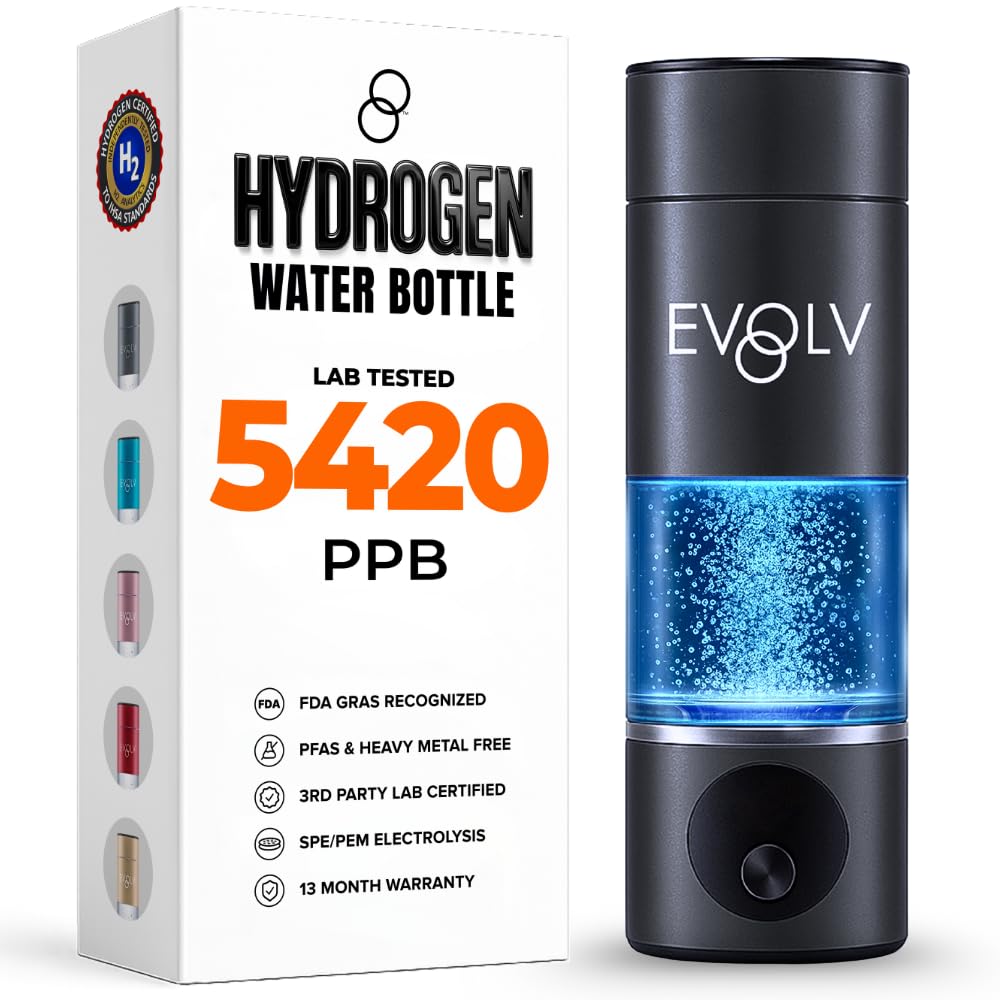
Pros and Cons of the EVOLV Hydrogen Water Bottle
What stands out
- Dual third-party certification — H2 Analytics and H2HUBB, verified by gas chromatography. A hydrogen-output certification shows output, not health outcomes.
- SGS heavy-metal testing — addresses the electrode-leaching risk that plagues cheap bottles.
- Built-in exhaust valve — vents chlorine and ozone byproducts away from the drinking side.
- Japanese SPE/PEM with Nafion N115 membrane — the membrane grade is actually disclosed, which is unusual.
- German food-grade polycarbonate, BPA-free construction.
- Two cycle options — 5-minute and 10-minute, so you can choose output.
Trade-offs to know
- The 5.4 PPM headline is a sealed-bottle peak, not a sustained drinking concentration — water at ordinary pressure holds roughly 1.6 mg/L at equilibrium.
- 8 oz is genuinely small. The manufacturer itself says you need 3–5 bottles a day.
- Premium price for a capacity most competitors beat.
- Electrode coating material is not explicitly disclosed — the membrane is, the electrodes are not.
- Some buyers report weak visible bubble output and difficulty returning the unit.
- Evidence limit — Hydrogen Water Safety has not independently measured this unit.
EVOLV Specifications and Technology
All specifications below are manufacturer-reported or third-party-certified, pulled from the current Amazon listing (ASIN B0DG32CKRB) and EVOLV’s published documentation. Hydrogen Water Safety has not independently measured this unit. Confirm the current spec sheet and which colour/variant you are buying before ordering — EVOLV lists several.
| Specification | Manufacturer / certified claim |
|---|---|
| Stated hydrogen output | 5.4 PPM (5,400 PPB) on the 10-minute cycle |
| Short cycle | 5 minutes → 2.5 PPM stated |
| Long cycle | 10 minutes → 5.4 PPM stated |
| Capacity | 8 oz (240 ml) |
| Membrane technology | Japanese SPE/PEM, Nafion N115 dual chamber |
| Electrode coating material | Not explicitly disclosed by manufacturer |
| Body material | German food-grade polycarbonate, BPA-free |
| Waste-gas handling | Built-in exhaust valve; vents chlorine and ozone |
| Third-party certification | H2 Analytics and H2HUBB, gas chromatography tested |
| Contaminant testing | SGS-tested for heavy-metal leaching |
| Charging | Magnetic USB charging cable |
| Stated lifespan | 5+ years per manufacturer |
The 5.4 PPM Claim: What It Actually Means
This is the single most important thing to understand before you spend money on the EVOLV — or on any bottle marketing a high PPM number.
The number is not fabricated. EVOLV is one of the very few consumer hydrogen bottles that submits to independent gas-chromatography testing, and both H2 Analytics and H2HUBB have certified output in the 5.4 PPM range. That is a real, documented measurement, and it is more than most brands in this category can produce.
But it is a sealed, pressurised, end-of-cycle peak — not what reaches your bloodstream. At standard temperature and pressure, water holds roughly 1.6 mg/L of dissolved molecular hydrogen at equilibrium. A sealed PEM bottle builds internal pressure during electrolysis, which is why a chamber reading can legitimately exceed that figure. The moment you unscrew the lid, the pressure drops and the excess hydrogen begins to leave solution, so the concentration falls. HWS has not measured where it settles for this bottle.
Why this still matters for the buying decision. Published hydrogen water studies report a range of dissolved hydrogen concentrations, and HWS has not independently verified the range used in any single study. A 5.4 PPM peak does not deliver “13× the benefit” — at most it delivers headroom, which may help when the water is imperfect, the membrane is partly fouled, or the cycle is shortened. Buy the EVOLV for its certification, venting, and materials testing. Do not buy it expecting to drink 5.4 PPM, because the sealed-chamber peak is not the concentration in the glass.
For the underlying chemistry, see our hydrogen water generator comparison, where we compare every device against the same roughly 1.6 mg/L equilibrium solubility.
Is the EVOLV Hydrogen Water Bottle Legit, or a Scam?
It is a legitimate product from an identifiable company (Evolv Wellness LLC), sold through Amazon fulfilment, with third-party lab certification that is unusually well documented for this category. On the two questions that actually separate a real hydrogen bottle from a scam — does it have genuine gas separation, and can anyone other than the seller verify the output — the EVOLV answers both.
Where the marketing overreaches is in framing. Claims of “up to 13× more hydrogen than others” and the health-benefit language on EVOLV’s own site run well ahead of what the clinical evidence supports. Hydrogen water is a wellness product; it is not established therapy for any condition, and no bottle changes that. Read the certification as real and the benefit claims as advertising. See our hydrogen water safety overview for what the research does and does not show.
How the EVOLV Works
The EVOLV uses electrolysis to split water into hydrogen and oxygen. The hydrogen dissolves into the drinking-side water; the oxygen — plus any trace chlorine or ozone produced along the way — is routed out through a separate channel. The component doing the separating is a Solid Polymer Electrolyte paired with a Proton Exchange Membrane, in EVOLV’s case a Nafion N115 dual-chamber membrane.
This matters more than any PPM figure. Without proper SPE/PEM separation, raw electrolysis passes byproducts straight into the water you drink — the failure mode of the cheapest unbranded bottles on the market. EVOLV’s built-in exhaust valve and disclosed membrane grade are the two specs a safety-first buyer should weigh most heavily. For why this is the central safety issue in the category, see our ozone gas warning.
Operation is a single button: one press starts the 5-minute cycle, a double press starts the 10-minute cycle. An LED confirms which is running.
What Verified Buyers Report
The following patterns come from published verified-purchase reviews on the Amazon listing. They are buyer reports, not measurements taken by Hydrogen Water Safety.
Recurring positives
- Build quality and packaging — repeatedly described as feeling premium in the hand.
- No taste change — several buyers, including self-described taste-sensitive ones, report the bottle does not alter the flavour of the water.
- Magnetic charging and single-button operation — consistently called easy and quick.
- Audible vacuum release on opening — buyers note a noticeable pressure release when unscrewing the lid after a cycle, which is consistent with a sealed chamber doing real work.
Recurring complaints
- The 8 oz capacity surprises people. This is the single most common complaint. Buyers accustomed to larger bottles find it too small to be practical, and the manufacturer’s own guidance of 3–5 bottles per day confirms the volume is modest.
- Weak visible bubble stream. At least one buyer comparing it against cheaper bottles reported far less visible bubbling and doubted it was working. Note that visible bubbles are a poor proxy for dissolved hydrogen — large bubbles mostly indicate gas escaping rather than dissolving — but it clearly affects buyer confidence.
- Return friction. A buyer reported the unit was listed as non-returnable and had to escalate to Amazon directly for a refund. Verify the return terms on your specific listing before ordering.
- Price relative to size. Buyers who did not check the capacity before ordering describe it as overpriced for what arrives.
EVOLV vs Echo Go+: How They Compare
The Echo Go+ is the most direct premium competitor. Neither unit has been lab-tested by Hydrogen Water Safety — neither unit has been lab-tested in-house, and this comparison rests on manufacturer specifications, third-party certification documents, and buyer-reported patterns.
The meaningful split: EVOLV leads on documented third-party certification (dual-lab gas chromatography plus SGS materials testing is rare in this category), while Echo leads on brand maturity and capacity. If your decision criterion is “which brand can prove its output claim to an independent lab,” EVOLV has the stronger paper trail. If it is capacity or ecosystem, look at Echo. For the full breakdown, see our Echo Go+ review, or our full EVOLV vs Echo Go+ head-to-head comparison.
The one bottle Hydrogen Water Safety owns and has handled is the Piurify — see the Piurify review if you specifically want a unit we have handled. For all options ranked side by side, see our best hydrogen water bottles guide.
Who Should Buy the EVOLV — and Who Should Skip It
Buy it if
- Third-party certification is your deciding factor and you are tired of self-reported PPB numbers.
- You want documented waste-gas venting and heavy-metal testing, not a mystery unbranded unit.
- You are comfortable with a small 8 oz serving and will genuinely drink several a day.
- You want headroom above the roughly 1.6 mg/L equilibrium solubility when conditions are imperfect.
Skip it if
- You want volume — 8 oz will frustrate you, and no cycle count fixes that.
- You are buying because of the 5.4 PPM figure specifically. That figure describes the moment the cycle ends, not the glass.
- You have kidney disease, are pregnant or nursing, or take prescription medication, and have not spoken to your doctor. See our medical disclaimer.
- You want the bottle we have personally used — that is the Piurify, not this.
Cleaning and Long-Term Ownership
EVOLV states the SPE/PEM filter does not require replacement but does require regular maintenance and cleaning, and sells replacement lid seals and charging cables. In practice, the ownership rules for the EVOLV are the same as for every PEM bottle: use distilled or filtered water rather than hard tap water, descale regularly to stop mineral film accumulating on the membrane, and never let the membrane dry out completely between uses. Our hydrogen water bottle cleaning guide covers the full routine.
Frequently Asked Questions
Does the EVOLV really produce 5.4 PPM of hydrogen?
The 5.4 PPM figure is third-party certified by H2 Analytics and H2HUBB using gas chromatography, so it is a real measurement — taken inside the sealed, pressurised bottle at the end of the 10-minute cycle. It is not what you drink. Once the lid is opened, the pressure drops and the concentration falls toward the roughly 1.6 mg/L equilibrium solubility; HWS has not measured where it settles. The certification is meaningful; the drinking concentration is not 5.4 PPM.
How long is the EVOLV cycle?
Two options. A single button press runs a 5-minute cycle, stated at 2.5 PPM. A double press runs a 10-minute cycle, stated at 5.4 PPM. An LED indicates which cycle is active.
Is the EVOLV hydrogen water bottle a scam?
No. It is a legitimate product from an identifiable company with genuine third-party lab certification — which is more than most bottles in this category can show. The criticism worth making is of the marketing, not the hardware: claims of 13× more hydrogen and the health-benefit language run ahead of what the clinical evidence supports. The bottle is real; the benefit claims are advertising.
How big is the EVOLV bottle?
8 oz (240 ml). This is small, and it is the most common complaint in verified-buyer reviews. EVOLV’s own guidance is to drink 3 to 5 bottles per day, which confirms the capacity is modest. If volume matters to you, this is the wrong bottle.
Does the EVOLV produce ozone?
Electrolysis of water can produce ozone and other oxidative species alongside hydrogen. The EVOLV is designed with a built-in exhaust valve intended to vent chlorine and ozone away from the drinking side, and it uses an SPE/PEM membrane for gas separation — the mechanism that addresses this risk. See our ozone gas warning for the full safety picture.
Can I use tap water in the EVOLV?
You can, but hard tap water with high total dissolved solids fouls PEM membranes and degrades output over weeks of daily use. Distilled or filtered water is strongly recommended for any PEM bottle, including this one.
Is the EVOLV worth the money?
It depends entirely on what you are paying for. If you are paying for verified third-party certification, documented gas venting, and SGS materials testing, it is one of the few bottles that can actually produce the paperwork. If you are paying for the 5.4 PPM headline, you are paying for a number you will never drink, and a cheaper certified bottle may do the same job.
Final Verdict
The EVOLV is one of the more defensible bottles in a category full of undefendable ones. Dual third-party gas-chromatography certification, SGS heavy-metal testing, a disclosed Nafion N115 membrane grade, and a real exhaust valve put it ahead of nearly every unbranded competitor on the specifications that actually govern safety. That is worth paying for.
What it is not worth paying for is the 5.4 PPM number. That figure is honestly measured and honestly certified, and it is still not what should be read as the concentration in your glass, for EVOLV or for any other unpressurised bottle. HWS has not measured where the EVOLV settles once opened.
Buy it if certification and materials testing are your criteria and the 8 oz capacity does not bother you. Skip it if you want volume, or if the headline PPM figure is the reason you were reaching for your card.
This verdict is based on research and analysis of manufacturer specifications, third-party certification documents, and verified-buyer feedback. Hydrogen Water Safety does not own this unit and has not lab-tested it. As an Amazon Associate, Hydrogen Water Safety earns from qualifying purchases.
Ready to check the EVOLV?
Prices change frequently — tap through for the current listing, current variant options, and current return terms.
Check Price on AmazonStill deciding between formats? Our best hydrogen water bottles guide ranks every portable option on certification, real output, and safety — and our hydrogen water generators guide covers countertop machines and pitchers if capacity is what you are missing here. You can also browse all of our hydrogen water reviews.
Last update on 2026-10-23 / Affiliate links / Images from Amazon Product Advertising API
This product presentation was made with AAWP plugin.