Hydrogen Bath: Does It Work? What the Studies Actually Say (2026)
Hydrogen Water Safety is reader-supported. When you buy through links on this page we may earn a commission. This does not affect what we recommend.
This article is for general information. It is not medical advice. Speak to a clinician about any health condition or before starting anything new. See our medical disclaimer.
A hydrogen bath is a warm bath with molecular hydrogen dissolved into the water, produced either by effervescent magnesium tablets or by an electrolysis unit placed in the tub. A small number of human trials have measured short-term changes in blood markers afterwards. Those trials used purpose-built equipment, not retail products, and the concentrations they achieved are lower than the figures printed on tablet packaging.
If you have seen a bath tablet advertised at a headline concentration and wondered whether a bathtub can hold that much dissolved gas, that is the right question. It is also one almost nobody answers, because answering it requires a number manufacturers do not print.
We have not used, measured, or tested any product named on this page. Every figure below is either from a named published study or from manufacturer documentation, and it is labelled as such. Our work here is arithmetic: checking advertised numbers against published physical constants and reporting where they disagree. If you want hydrogen water to drink rather than bathe in, our hydrogen water tablets comparison covers drinking tablets, which use the same magnesium reaction.
What a Hydrogen Bath Is
There are two ways to make one at home. Magnesium tablets dissolve in the water and react with it, producing hydrogen gas and magnesium hydroxide. The reaction is Mg + 2H2O, the same chemistry used in the drinking tablets sold across this category. An electrolysis generator instead splits water at an electrode and releases hydrogen directly into the tub.
Two routes are proposed for how any of it reaches you. One is absorption through the skin. The other is inhaling hydrogen that escapes the water surface into the bathroom air. Both are plausible and both appear in the literature as proposals.
Which one accounts for what the trials measured has not been isolated in any published study. That matters more than it sounds. A bath presents the largest open water surface in a house, so a substantial share of the gas leaves the water and enters the room you are sitting in. Any effect recorded after a soak could reflect either pathway, and no published work separates them.
The Arithmetic Behind the Claims
This calculation needs no laboratory. Anyone can repeat it with a label figure and a constant.
Start with volume. A standard bath holds roughly 30 to 40 US gallons, about 114 to 151 litres. We will use 130 litres as a working figure.
Next, the concentration research actually achieved. In the trial published by Tanaka and colleagues in Medical Gas Research in 2022, the bath apparatus reached 338 to 682 micrograms per litre of dissolved hydrogen after 120 minutes of electrolysis. In the units used on packaging, that is 0.34 to 0.68 ppm.
Now the chemistry. Magnesium releases hydrogen at a fixed ratio. Magnesium weighs 24.3 grams per mole and hydrogen 2.02, so each milligram of magnesium can yield about 0.083 mg of hydrogen if it reacts completely.
| To reach this concentration | Hydrogen needed in 130 L | Magnesium required |
|---|---|---|
| 0.34 ppm (study low end) | 44 mg | about 530 mg |
| 0.68 ppm (study high end) | 88 mg | about 1,060 mg |
| Typical drinking tablet, 80 mg magnesium | 6.6 mg | yields about 0.05 ppm |
A standard drinking tablet dropped into a bath produces roughly 0.05 ppm across 130 litres. That is seven to thirteen times below the concentration used in the research.
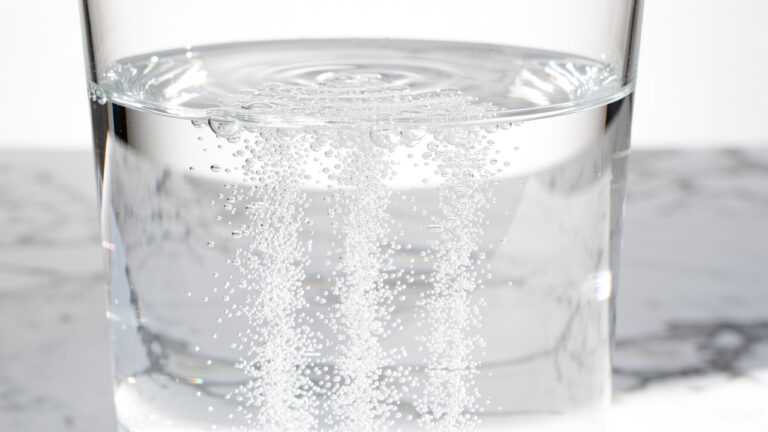
Here is the complication. That calculation is generous. It assumes every atom of magnesium reacts and no gas escapes, and neither holds. Water at room temperature and normal atmospheric pressure carries only about 1.6 mg/L of dissolved hydrogen at saturation, and warm water carries less, because gas solubility falls as temperature rises. A bath is warm, open, and enormous in surface area. The surplus leaves as visible fizzing, exactly as it does in a glass.
So a bath tablet has to be considerably larger than a drinking tablet to land anywhere near the research concentration. Whether any given product is depends on its magnesium content, and most manufacturers do not publish that figure per tablet, nor the concentration their product achieves in a stated water volume. Without both numbers, an advertised concentration cannot be checked by anyone.
What the Research Measured
The human evidence is small, short, and concentrated in a few research groups. Here is what it reports, with the numbers as published.
Antioxidant and inflammatory markers
Tanaka and colleagues, writing in Medical Gas Research in 2022, measured blood markers in healthy subjects after a ten-minute soak. Serum oxygen radical absorbance capacity rose to 110.9 plus or minus 9.2 percent of baseline at 120 minutes after the bath. A ten-minute normal-water bath at 40C produced no change. Serum C-reactive protein, a standard inflammation marker, fell to 70.2 plus or minus 12.1 percent of baseline over the same window, while the normal-water bath raised it slightly.
The same paper reports findings in patients. In people with connective tissue disease, CRP was repressed to between 3 and 24 percent of baseline over periods of nine days to four months of bathing. In a further six patients with autoimmune-related conditions bathing daily for two to twenty-five months, mean pre-bathing CRP fell from 5.31 to 0.24 mg/dL.
Those patient findings involve very small numbers. The autoimmune group was six people. They were not randomised against a control in the way the healthy-subject arm was, and no independent group has replicated them. They are worth reporting and they are not worth building a purchase on.
Skin findings
A randomised trial published in Scientific Reports in 2018 studied hydrogen-water bathing in patients with psoriasis and parapsoriasis en plaques. Of the bathing group, 56.1 percent — 23 of 41 patients — achieved at least a 50 percent improvement in Psoriasis Area and Severity Index score, against 17.7 percent, or 6 of 34, in the control group, at P equals 0.001. Itching sensation was reported markedly reduced in most cases.
That was a diagnosed patient population studied under supervision. It is not a statement that a home hydrogen bath treats a skin condition, and it should not be read as one. Anyone with psoriasis or any other skin condition should be working with a clinician.
The gap between the research and the products
Every trial above used purpose-built electrolysis apparatus, in most cases run for two hours before anyone got in. None of them tested a retail tablet dropped into a domestic tub.
Research on a category is not evidence about a product. Nothing published establishes that any consumer bath tablet reaches the concentrations these studies used, because no manufacturer publishes the concentration its tablet produces. That gap is the single most useful thing to hold in mind while reading any marketing on this subject.
Tablets or a Generator
Tablets are genuinely simple. Nothing to plug in, nothing to maintain, nothing to store. Generators leave no residue and can run for as long as you like. Both are reasonable choices, and the differences are practical rather than clinical.
| Magnesium bath tablets | In-tub electrolysis generator | |
|---|---|---|
| Mechanism | Mg + 2H2O | Electrolysis at a membrane electrode |
| Published bath concentration | Not published by manufacturers | 338–682 micrograms per litre after 120 minutes — one apparatus, Tanaka 2022 |
| Magnesium per tablet | Rarely published | Not applicable |
| Residue | Magnesium hydroxide | None |
| Ongoing cost | Repurchase per bath | Electrode descaling |
| Main practical risk | Magnesium exposure | Electrical safety in a wet room |
Products currently sold in this category include Molecular H2TAB Hydrogen Bath Tablets, DrinkHRW Relief bath tablets, and the Echo Revive unit. We have not used any of them and publish no measurements of our own. For the drinking-tablet equivalents, see our hydrogen water tablets comparison, or browse all of our hydrogen water reviews.
If you bathe occasionally, tablets are the lower-commitment option. If you intend to do this several times a week, a generator removes the repurchase and the residue.
Doing It Safely at Home

Follow the tablet count or generator run time printed on the product you bought. There is no universal number, and anyone who gives you one without naming a product is guessing.
- Get in promptly. Dissolved hydrogen begins leaving the moment it is made. The same open-vessel logic that makes tablet instructions say to drink immediately applies to a bathtub, only more so.
- Temperature is for comfort, not chemistry. Warm water holds less dissolved gas than cool water, not more. Choose the temperature you find comfortable and do not expect a warmer bath to retain hydrogen better.
- Ventilate the room. Hydrogen leaving the water enters the air. Run the extractor or leave the door ajar.
- Treat generators as bathroom electronics. Mains-powered devices near a filled tub belong on a GFCI-protected circuit, with the power unit dry and outside the water. This is standard electrical practice for any appliance used near plumbing, and manufacturer instructions will say the same.
If a device vents gas other than hydrogen, that is a design question worth asking the manufacturer about directly. See our note on ozone and byproduct gases for why membrane design matters in electrolysis units.
Safety and Magnesium
Dissolved hydrogen at these concentrations is not a recognised safety concern. The variables actually worth attention are the ones that come with the delivery method.
Magnesium is the one to watch in tablet products, as it is with drinking tablets. Established guidance sets the upper intake level for supplemental magnesium at 350 mg per day for adults, and magnesium is cleared by the kidneys, which is why kidney function is the specific concern. Bathing is not oral intake and the two are not directly comparable, but anyone managing magnesium on clinical advice should raise it with their clinician rather than assume the route makes it irrelevant.
Hot-water immersion causes blood vessels to dilate and blood pressure to drop. That is a property of hot baths generally and has nothing to do with hydrogen. Pregnancy and cardiovascular conditions are clinician questions, and the guidance you should follow is the guidance you are given, not a number from a website.
The Bottom Line
The published research supports a narrow claim: short-term shifts in blood markers, measured in small trials, plus one randomised skin trial in diagnosed patients. All of it used purpose-built equipment. None of it establishes that a retail bath tablet delivers the same thing.
There are two numbers to ask any manufacturer for: the magnesium content per tablet, and the concentration that tablet produces in a stated volume of water. With both, the arithmetic above lets you check the claim yourself. Without them, the advertised figure cannot be verified by anyone, including us.
We have not measured any product on this page and no figure here was produced by us. If you want to try a hydrogen bath, the honest position is that it is an early-evidence practice with a plausible mechanism and thin human data, and that the concentration you achieve at home is probably well below what the studies used.
Frequently Asked Questions
How long does dissolved hydrogen last in a bath?
It starts leaving immediately, and warm water holds less than cool water does. No published figure gives a reliable retention time for a domestic bathtub, so any specific number you see quoted is an estimate rather than a measurement. Manufacturer guidance is to get in promptly after preparing the water.
Can you make a hydrogen bath with a hydrogen water bottle?
No. A bottle produces a few hundred millilitres. A bath is well over a hundred litres. Even several full bottle cycles poured in would be diluted by a factor of several hundred before you accounted for gas escaping the surface. Bottles and home methods for drinking water are a different application.
What are hydrogen bath tablets?
Effervescent tablets containing elemental magnesium, which reacts with water to release hydrogen gas and leave magnesium hydroxide behind. The chemistry is the same as drinking tablets. The magnesium content per tablet is rarely published, which is the figure you would need to work out what concentration the tablet can actually produce.
Are hydrogen baths safe during pregnancy or with a heart condition?
The hydrogen is not the concern. Hot-water immersion is, because it lowers blood pressure through vasodilation, and that applies to any hot bath. Anyone pregnant or managing a cardiovascular condition should follow their own clinician’s guidance on hot baths rather than a general recommendation from an article.
Does bathing replace drinking hydrogen water?
They are different exposure routes and neither has been shown to substitute for the other. It is worth knowing that even for bathing, the published trials have not isolated whether the effect comes through the skin or through inhaling gas escaping the water surface.
How much magnesium is in a hydrogen bath tablet?
Most manufacturers do not publish it. That matters more than it might seem, because without the magnesium content there is no way to calculate what concentration the tablet can produce in a given volume of water, and therefore no way to check the concentration claim on the packaging.
How often should a bath generator be descaled?
Follow the interval stated by the manufacturer of your unit. Scale build-up depends on local water hardness and on the specific electrode design, so there is no universal figure. The same principle applies to cleaning a hydrogen water bottle.
Sources cited: Tanaka Y. et al. (2022), Hydrogen-rich bath with nano-sized bubbles improves antioxidant capacity based on oxygen radical absorbing and inflammation levels in human serum, Medical Gas Research 12(3):91-99. Zhu Q. et al. (2018), Positive effects of hydrogen-water bathing in patients of psoriasis and parapsoriasis en plaques, Scientific Reports. Product figures are manufacturer-stated where given. For how we evaluate products and what our evidence does and does not cover, see our evaluation method.