
Affiliate disclosure: As an Amazon Associate, Hydrogen Water Safety earns from qualifying purchases. Editorial verdicts are not affected by affiliate relationships.
Not medical advice. Hydrogen water bottles are wellness products, not medical devices. Consult a qualified healthcare provider for any health concern.
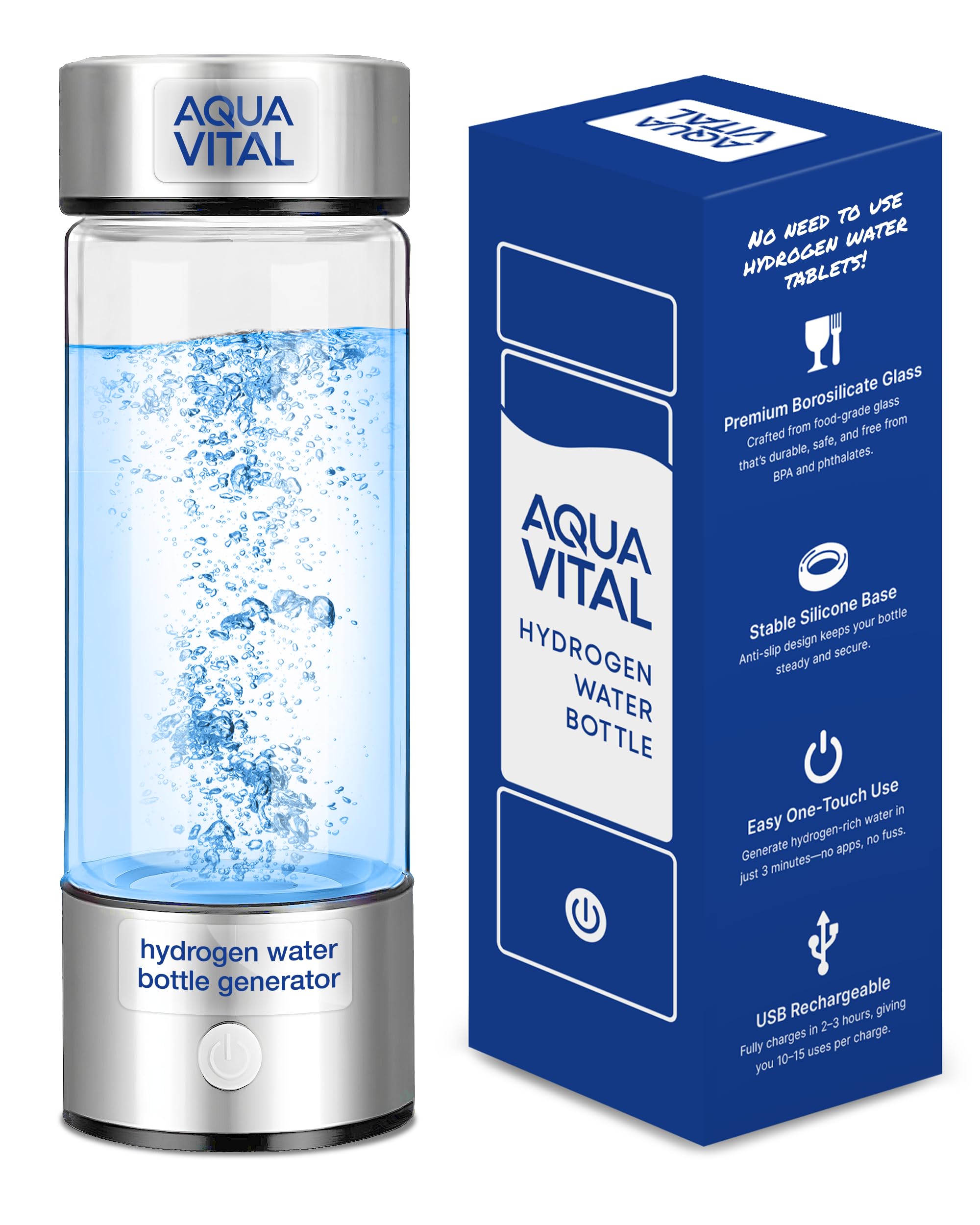
Aqua Vital Hydrogen Water Bottle
A 16 oz glass SPE/PEM electrolysis bottle sold under the Aqua Vital name through a direct-to-consumer site and, on Amazon, under the FREEZE2TRIM brand. The listing states cycle time, battery and capacity but no hydrogen concentration; the press release claims one; five marketing pages report five different customer ratings. The hardware is a standard budget-tier generator. The marketing is the reason to read this page.
Best for: someone who wants a basic 16 oz rechargeable hydrogen bottle at the budget end of the market and is buying it for what the listing states, not for what the advertorials promise.
Pricing varies; check current price on Amazon for accurate figures.
Aqua Vital Pros and Cons
✓ Pros
- ✓SPE/PEM electrolysis — the membrane type that separates hydrogen from the oxygen and ozone by-products, per the listing
- ✓Glass body, 16 oz / 470 ml — larger than most budget bottles, which run 9–14 oz
- ✓USB-C charging, roughly three hours to full and about ten cycles per charge, per the listing
- ✓Automatic shut-off after each cycle; two beeps signal completion
- ✓No filters or consumables — the listing states zero ongoing costs
- ✓Wide mouth for cleaning; brushed-steel base with silicone pad
✗ Cons
- ✗No hydrogen concentration stated anywhere on the Amazon listing
- ✗No third-party test report cited by the seller; no certification body named
- ✗Sold under two names — “Aqua Vital” direct and “FREEZE2TRIM” on Amazon — with no manufacturer identified on either
- ✗Standard screw lid: no pressure retention, so hydrogen escapes as it would from any open glass
- ✗Customer ratings quoted by marketing pages range from 2.9 to 4.98 out of 5 — none traceable to a marketplace
- ✗Limitation: Hydrogen Water Safety has not measured this unit’s output
Aqua Vital Specifications: What the Listing States
Everything in this table is taken from the Amazon listing’s own feature bullets. Where the listing is silent, the row says so.
| Spec | Seller statement (Amazon listing, September 2026) |
|---|---|
| Dissolved hydrogen concentration | Not stated on the listing. The August 2025 press release claims “up to 1,700 ppb in a single cycle”; see the claims section below. |
| Electrolysis type | SPE / PEM (solid polymer electrolyte, proton-exchange membrane) |
| Capacity | 16 oz / 470 ml (one independent review page reports 420 ml; the listing says 470) |
| Body material | Glass, with brushed-steel base and silicone pad |
| Cycle time | About 3 minutes; two beeps at completion; a second cycle can be run for a stronger result, per the listing |
| Battery | 1,000 mAh lithium-polymer; ~3 hours to charge; roughly 10 cycles per charge |
| Charging | USB-C; red LED while charging, steady blue when full |
| Auto shut-off | Yes, after each cycle |
| Lid | Standard screw lid; no pressure-retention claim |
| Filters / consumables | None |
| Third-party testing | None cited on the listing |
| Manufacturer | Not identified. Amazon brand field: FREEZE2TRIM. Direct site: “Aqua Vital” |
| Warranty | Not stated in the listing text; check the seller’s terms |
| Price | Check current price on Amazon |
The empty first row matters more than every row beneath it. A device whose sole purpose is producing hydrogen gas, yet whose own listing will not say how much it produces, is asking you to trust a number that appears nowhere on the page you are buying from.
How the Aqua Vital Bottle Works
The mechanism is the same one inside every rechargeable hydrogen bottle in this price band. A small current is passed across water in the base of the bottle. At one electrode, water is split and hydrogen gas is released into the drinking chamber; at the other, oxygen — and, in poorly designed cells, ozone and chlorine — is produced. A solid polymer electrolyte membrane between the electrodes lets protons cross while keeping the gases separated, and the by-products are vented out through the base rather than into the water. That is what “SPE/PEM” on the listing refers to, and it is the feature that distinguishes a bottle worth considering from one that is not.
The listing states that a full cycle takes about three minutes, that the bottle beeps twice and switches itself off, and that a second cycle can be run “for an even stronger boost.” That last line is worth understanding. Water at room temperature and normal pressure holds roughly 1.6 mg of dissolved hydrogen per litre. A three-minute cycle in an open-lidded bottle produces hydrogen faster than the water can dissolve it; the visible bubbles are the surplus leaving. Running a second cycle can raise the dissolved figure toward that ceiling, but an open bottle does not hold much above it for long: because dissolved hydrogen does not keep building past that level, a fresh short burst just before drinking is the only way to raise what is actually in the glass. A standard screw lid does not hold pressure, so whatever the bottle produces begins escaping the moment the cycle stops.
The listing gives no figure for how close to that ceiling the bottle gets. That is not unusual for a budget generator, but it is the one number the health case depends on, and its absence is the reason this review has a claims section.
The Claims Audit: Listing vs Press Release vs Advertorials
Search this product’s name and the first page of results is almost entirely paid distribution: a GlobeNewswire press release syndicated to Yahoo Finance, a Barchart advertorial, and a cluster of “review” pages that link to an official store. Hydrogen Water Safety read each of them and compared what they claim against what the Amazon listing states. The three layers do not agree.
| Claim | Amazon listing | Press release (GlobeNewswire, 26 Aug 2025) | Affiliate “review” pages |
|---|---|---|---|
| Hydrogen concentration | Not stated | “Up to 1,700 ppb in a single cycle,” with a higher multi-cycle figure | “800–1,200 PPM” (tekchive.com) — a thousand-fold unit error; 1,000 ppm would be roughly 600 times hydrogen’s solubility limit |
| Customer rating | Live on the listing; not reproduced here | None | 4.98/5 from “2,000+” (nuvectramedical.com); 4.8/5 from “3,758” (billdoo.com); 4.94/5 from “23,622” (hdieet.org); “4.2–4.5” (scribehow.com); 2.9/5 (waterbottleinfo.com) |
| Product category | Sports water bottle | Hydrogen water bottle | “A cutting-edge dietary supplement” (nuvectramedical.com) |
| Where to buy | Amazon, brand FREEZE2TRIM | “Official Aqua Vital website” | “Always buy from the official website” (scribehow.com) |
| Health effects | None claimed | Antioxidant and “cellular signaling” benefits at 0.3–1.2 ppm, citing unnamed studies | Concussion recovery, sleep, dizziness, inflammation, bloating (testimonials, nuvectramedical.com and billdoo.com) |
Three things follow. First, the only concentration figure anywhere in the chain — 1,700 ppb, or 1.7 mg/L — comes from a press release, not from the listing or a test report, and it sits just above the solubility ceiling for an open bottle, which is where a well-performing SPE cell would land. It is plausible. It is also unverified by anyone the seller names.
Second, the rating claims cannot all describe the same product. A 4.98 from two thousand reviews and a 2.9 from an independent page are not the same customer base, and a count of 23,622 reviews for a bottle launched in 2025 is not consistent with any marketplace listing Hydrogen Water Safety could find. The only rating a buyer can actually check is the one on the Amazon product page itself, which is why this review does not repeat any of the others as fact.
Third, the “dietary supplement” description and the testimonial health claims are not the seller’s — they belong to affiliate pages — but they are what a searcher meets first. A rechargeable bottle is not a supplement, and the Amazon listing, to its credit, makes no health claim at all. Judge the product by the listing, not by the pages that sell it hardest.
Checking the listing yourself?
The Amazon page carries the only customer rating that can be verified, and the current price.
Is Aqua Vital Worth the Money?
Strip away the distribution and what remains is a budget-tier 16 oz SPE/PEM glass bottle with a 1,000 mAh battery, a three-minute cycle and no published output figure. That describes a large share of the generator bottles on Amazon, including the generic 480 ml SPE/PEM unit in our hydrogen water generators comparison. The Aqua Vital hydrogen water bottle’s real advantages inside that group are the glass body and the 16 oz capacity; many rivals at the same tier use polycarbonate and hold 9–14 oz.
Where it does not compete is with bottles that publish and certify their output. The Echo Flask states a concentration and cites a third-party report; PIURIFY’s bottle carries a named certification. Those bottles cost more, and they give a buyer a number to hold the seller to. The Aqua Vital gives none. If the current Amazon price is in the budget band, it is a fair price for the hardware the listing describes. If it is priced against the certified bottles, the buyer is paying a premium for advertising.
One practical check before buying: compare the Amazon price with the direct site’s price. Two-channel products of this kind frequently price differently by channel, and Amazon’s return policy is the more predictable of the two.
Is Aqua Vital Safe?
Dissolved hydrogen at the concentrations any bottle can reach is not a recognised safety concern; the body clears it within hours and the published safety literature has not identified toxicity at drinking-water levels. The safety questions for electrolysis bottles are about the cell, not the gas.
Ozone and chlorine. Electrolysis without a separating membrane can put ozone and, from chlorinated tap water, chlorine by-products into the drinking chamber. The listing states SPE/PEM construction, which is designed to vent those gases through the base. That is the right claim to see. It is also unverified by any test the seller cites, and a swimming-pool smell from the water after a cycle is the buyer’s signal that the membrane is not doing its job. Our ozone gas warning explains what to check.
Materials. Glass in contact with the water avoids the plasticiser questions that follow polycarbonate bottles. The listing does not state the electrode material; platinum-coated titanium is standard for SPE cells and the seller should confirm it on request.
Battery. A 1,000 mAh lithium-polymer cell in the base is normal for the category. Keep the base dry, charge from a low-power USB port rather than a fast charger, and stop using the unit if the base swells or warms during charging.
Who should not. This is a wellness product, not a medical one. Anyone with a diagnosed condition, anyone pregnant or nursing, and anyone on medication whose dose must be kept within a tight range should ask a clinician before adding a daily wellness routine of any kind. See is hydrogen water safe for what the research does and does not establish.
Cleaning, Maintenance, and Long-Term Ownership
The listing’s own claim is “zero ongoing costs,” and for consumables that is true — there is no filter or cartridge. The ongoing cost is attention. Electrolysis cells scale with mineral deposits from hard water, output falls as they do, and the fix is a routine, not a part.
- Rinse the chamber after each use and leave the lid off to dry; the listing’s wide mouth makes this straightforward.
- Once a week, run a cycle with a mild citric-acid or white-vinegar solution, then two cycles with clean water, to dissolve scale on the electrode plate.
- Never submerge the base; the battery and cell electronics sit there.
- If bubble production visibly drops or the water develops a chemical smell, descale first and, if that fails, stop using the unit — see the safety section.
Our general guide to cleaning a hydrogen water bottle covers the routine in more detail. On lifespan, the listing makes no claim about cycle count or membrane life, and neither does the press release; that is a question for the seller before purchase.
Aqua Vital vs Echo Flask: How They Compare
The Echo Flask is the bottle most often held up as the premium reference in this category, and the comparison is useful precisely because the two occupy different tiers. Every Echo figure below is the manufacturer’s or its cited third party’s, as set out in our Echo Flask and Echo Go+ review.
| Criterion | Aqua Vital | Echo Flask |
|---|---|---|
| Concentration claim | None on listing; 1,700 ppb in press release | Manufacturer states a figure and cites a third-party report |
| Third-party testing named | No | Yes, per manufacturer |
| Pressure-retaining lid | No — standard screw lid | Yes, per manufacturer |
| Body | Glass, 16 oz | See Echo review for current model specification |
| Manufacturer identified | No | Yes — Echo Water |
| Brand consistency across channels | Two names, two channels | One brand |
| Price tier | Budget | Premium |
The honest summary: the Aqua Vital is not a cheaper Echo Flask. It is a cheaper bottle that makes hydrogen, sold with an Echo-sized marketing budget. Buyers who want the certification and the sealed lid should read the Echo page and pay for them. Buyers who want a basic glass generator should compare the Aqua Vital against the other budget SPE bottles on our best hydrogen water bottles list, where its glass body and capacity are real advantages and its missing spec is a shared weakness.
Who Should Buy Aqua Vital (and Who Shouldn’t)
A reasonable fit if
- You want to try hydrogen water without spending premium money, and you accept that the output figure is unpublished.
- You prefer glass to polycarbonate and want a full 16 oz per cycle.
- You are buying on Amazon, where the customer rating is real and the return window is clear.
Look elsewhere if
- You want a stated, certified concentration — the Echo Flask and PIURIFY bottles publish one; this does not.
- You want hydrogen to last in the bottle — you need a pressure lid, which this does not have.
- You found this product through a page promising concussion recovery, sleep or inflammation results. Those are testimonials on affiliate pages, not claims the seller makes and not findings from research on this device.
- You want to know who made it. Neither channel identifies a manufacturer.
Frequently Asked Questions
Is Aqua Vital legit?
The product is real and sold on Amazon under the FREEZE2TRIM brand and directly under the Aqua Vital name. What is not legitimate is much of the marketing around it: five promotional pages quote five different customer ratings, none traceable to a marketplace, and one affiliate page calls a water bottle a dietary supplement. Judge it by the Amazon listing, which makes no health claims and states its specifications plainly.
How much hydrogen does the Aqua Vital bottle produce?
The Amazon listing does not say. The August 2025 press release claims up to 1,700 ppb (1.7 mg/L) in one cycle, which is close to the solubility ceiling for an open bottle and would be a good result for an SPE cell — but no test report is cited and Hydrogen Water Safety has not measured it. Affiliate pages quoting “800–1,200 PPM” have confused ppb with ppm by a factor of one thousand.
Is Aqua Vital the same as the Echo Flask?
No. Both are rechargeable SPE/PEM hydrogen bottles, but the Echo Flask publishes a concentration, cites third-party testing and uses a pressure-retaining lid; the Aqua Vital does none of those things and sells at a lower tier. See our Echo Flask review for the comparison in full.
Why is the Amazon brand FREEZE2TRIM and not Aqua Vital?
The same 16 oz bottle is sold through two channels: a direct-to-consumer “Aqua Vital” site promoted by press releases and advertorials, and an Amazon listing whose brand field reads FREEZE2TRIM. Neither identifies the manufacturer. This is common with rebranded generator bottles and is not itself a defect, but it means there is no manufacturer to hold to a specification.
Does Aqua Vital work with reverse-osmosis or distilled water?
The Amazon listing does not address water type. One promotional page reproducing the direct site’s instructions says to use mineral or spring water and avoid purified or RO water, while also saying distilled is acceptable — the two statements conflict. Very low-mineral water slows electrolysis in many bottles of this type; if you use RO water and see weak bubbling, that is the likely reason.
How long does the hydrogen stay in the water?
With a standard screw lid, not long. Dissolved hydrogen leaves an unpressurised bottle over minutes to a few hours, which is why the listing’s advice to drink promptly after a cycle is correct. Our guide on how long hydrogen water lasts explains the physics; bottles that retain hydrogen for longer do so with sealed, pressure-holding lids.
Is Aqua Vital safe to use every day?
The hydrogen is not a concern at these concentrations. The things to watch are the same as for any electrolysis bottle: a chemical smell after a cycle, which suggests the membrane is not venting by-products correctly; scale on the electrode plate, which a weekly citric-acid cycle addresses; and battery care in the base. Anyone with a diagnosed condition should ask a clinician before adopting a daily wellness routine.
Final Verdict: Is Aqua Vital Worth Buying?
As hardware, the Aqua Vital is a competent budget-tier hydrogen bottle: SPE/PEM electrolysis, glass, 16 oz, USB-C, auto shut-off, no consumables. Those are the features a buyer at this price should want, and the listing states them clearly. Against other budget SPE bottles it is a reasonable choice, with capacity and material in its favour.
As a product story, it is the opposite. The listing publishes no concentration, the seller names no test, no manufacturer is identified, and the promotional pages that surround it contradict each other on the most basic fact — how satisfied its buyers are — by two full stars. None of that makes the bottle worse. It means the buyer should ignore everything except the listing and the live rating on it.
This is a specification and claim audit. Hydrogen Water Safety has not lab-tested the Aqua Vital unit and publishes no hydrogen measurements of its own. All performance figures are the seller’s or the press release’s, each attributed above, and none has been independently verified by a party the seller names.
See the Aqua Vital Listing on Amazon
Verified customer rating and current price, on the only page that carries both. As an Amazon Associate, Hydrogen Water Safety earns from qualifying purchases.
This review is part of Hydrogen Water Safety’s coverage of rechargeable hydrogen bottles. For the category compared on published specifications, see best hydrogen water bottles; for the premium reference, the Echo Flask review; for the one device this site owns and has used daily, the PIURIFY review; and for the physics behind every concentration claim, how long hydrogen water lasts. You can also browse all of our hydrogen water reviews.
Last update on 2026-10-25 / Affiliate links / Images from Amazon Product Advertising API
This product presentation was made with AAWP plugin.