
Affiliate disclosure. Hydrogen Water Safety is reader-supported. As an Amazon Associate we earn from qualifying purchases. When you buy through links on this page we may earn a commission at no additional cost to you. This does not change which products we recommend or how we describe them. We do not accept sponsored reviews, free units, or paid placement from any brand listed here. Read our full affiliate disclosure.
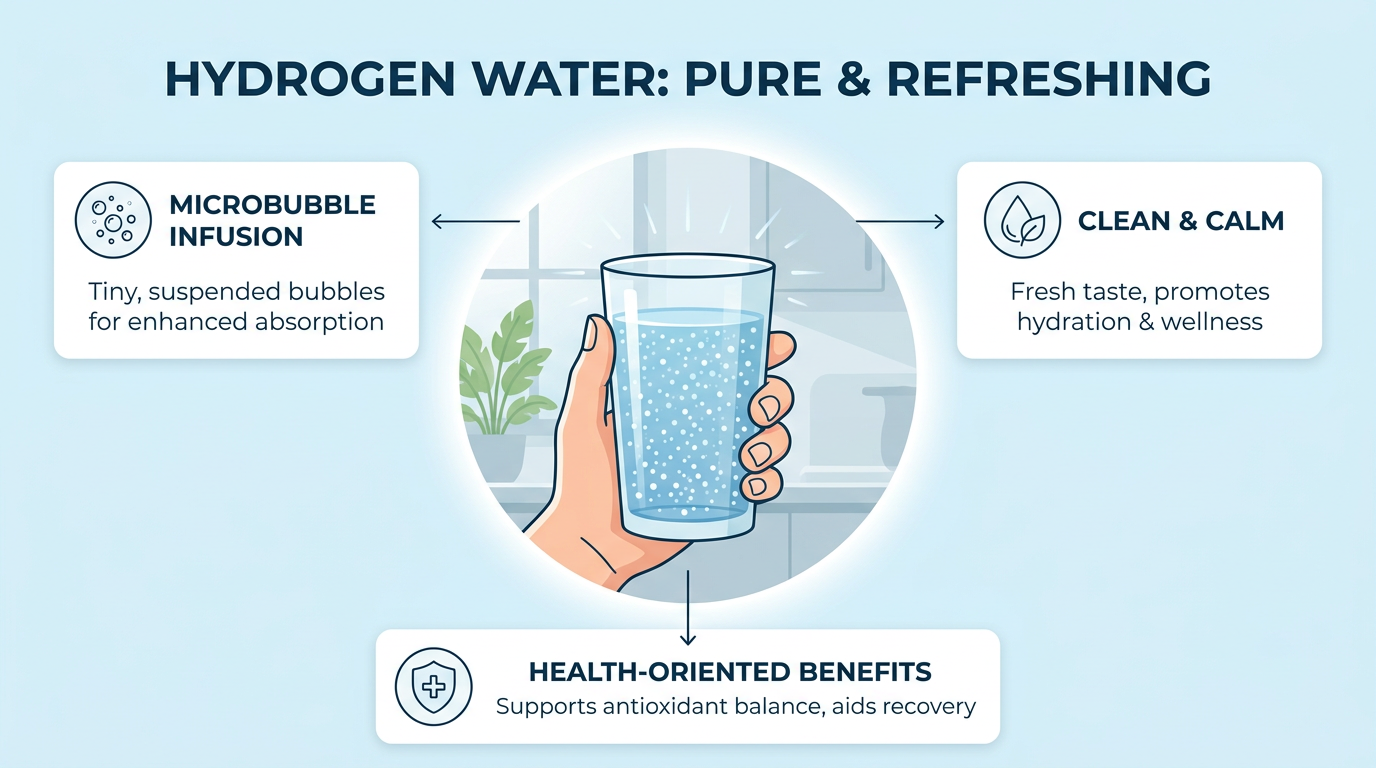
Real hydrogen water pitchers exist — but most products labeled “hydrogen” are passive filter pitchers using alkaline stones or magnetic rings with no electrolysis technology inside. The rule is straightforward: a legitimate hydrogen water pitcher must contain a powered SPE/PEM electrolysis cell. Without one, no measurable molecular hydrogen is produced. This guide covers four pitchers whose listings disclose SPE/PEM technology and shows you how to tell them apart from the fakes.
Our Top Picks at a Glance
- Best overall: PIURIFY 50 oz — calcium-sulfite filter, listing states 700-1,300 PPB. CHECK PRICE
- Highest stated output: PUREPEBRIX 72 oz — listing states 3,000 PPB, iridium-platinum electrodes. CHECK PRICE
- Best large-capacity value: HydroPitcher 68 oz — BPA-free, SPE/PEM disclosed. CHECK PRICE
- Best mid-range: 2L SPE/PEM Pitcher — platinum-titanium plates, listing states 1,500 PPB. CHECK PRICE
Key Takeaways
- A legitimate hydrogen water pitcher requires a powered SPE/PEM (Solid Polymer Electrolyte / Proton Exchange Membrane) electrolysis cell — passive filter pitchers produce no measurable H₂.
- All PPB figures in this article reflect manufacturer listing statements only and have not been independently measured.
- Dissolved molecular hydrogen dissipates rapidly once a container is opened — drink promptly after production.
- Checking the listing for explicit SPE/PEM disclosure and a gas-vent port is the most reliable safeguard against misleading marketing.
- Hydrogen water pitchers infuse H₂ but do not remove contaminants like lead, PFAS, or heavy metals — a separate filtration system is still necessary.
How Hydrogen Water Pitchers Work — and How to Spot a Fake
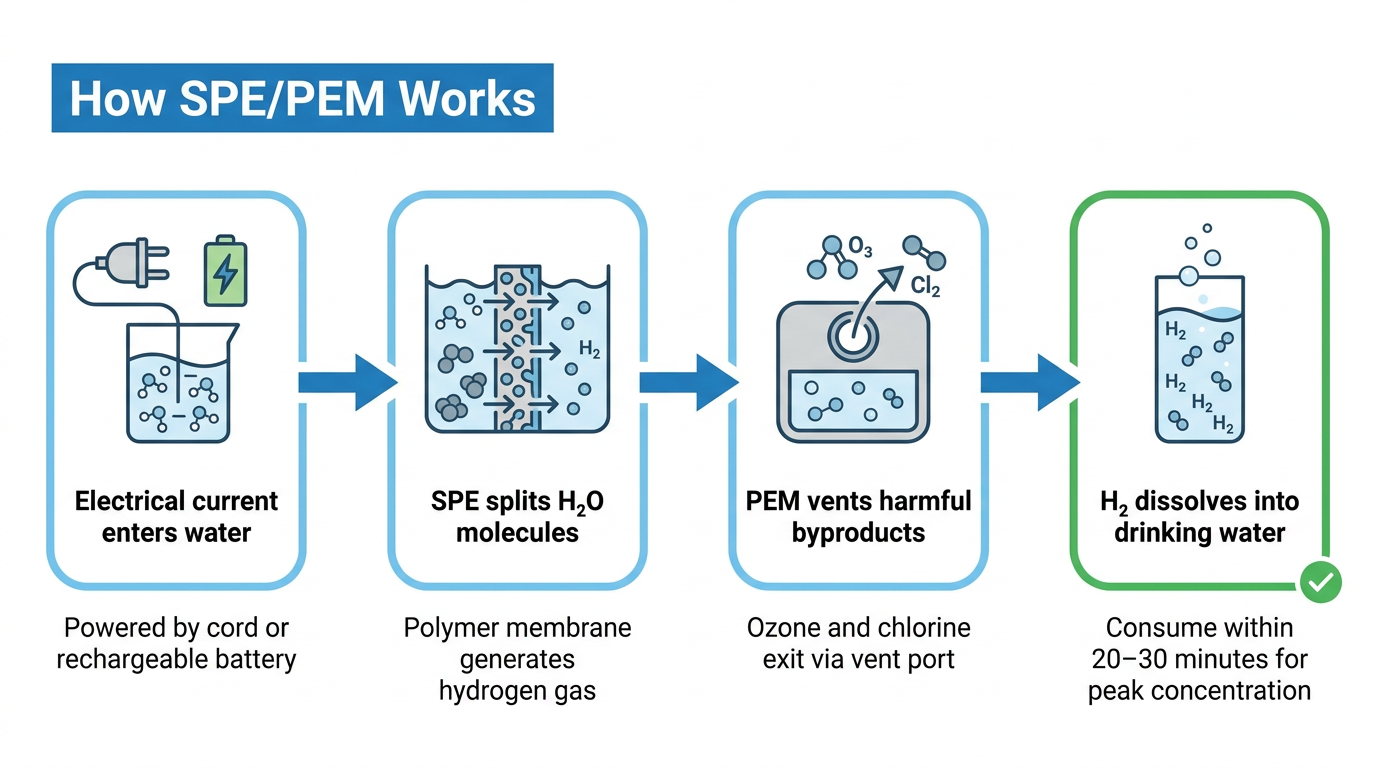
Hydrogen water pitchers produce hydrogen-rich water through electrolysis, an electrochemical process that passes an electrical current through water, splitting H₂O molecules to release molecular hydrogen gas. That gas then dissolves back into the water at elevated concentrations. Technology quality, however, varies enormously across devices.
The gold standard is SPE/PEM technology — a Solid Polymer Electrolyte paired with a Proton Exchange Membrane. The SPE generates hydrogen gas efficiently using a polymer membrane rather than a basic electrode setup. The PEM then acts as a selective barrier, allowing only protons to pass while separating and venting unwanted byproduct gases — ozone and chlorine — away from the drinking water. Devices without PEM separation can push these unwanted gases directly into the water you consume.
Passive filter pitchers are the counterfeit version of this technology. They use alkaline stones, magnetic rings, or ceramic media with no powered electrolysis cell. Labels like “hydrogen-enriched,” “alkaline hydrogen,” “structured water,” or “magnetic infusion” are marketing language, not technology descriptors. None of these produce measurable molecular hydrogen.
The 4-point checklist to spot a fake before you buy
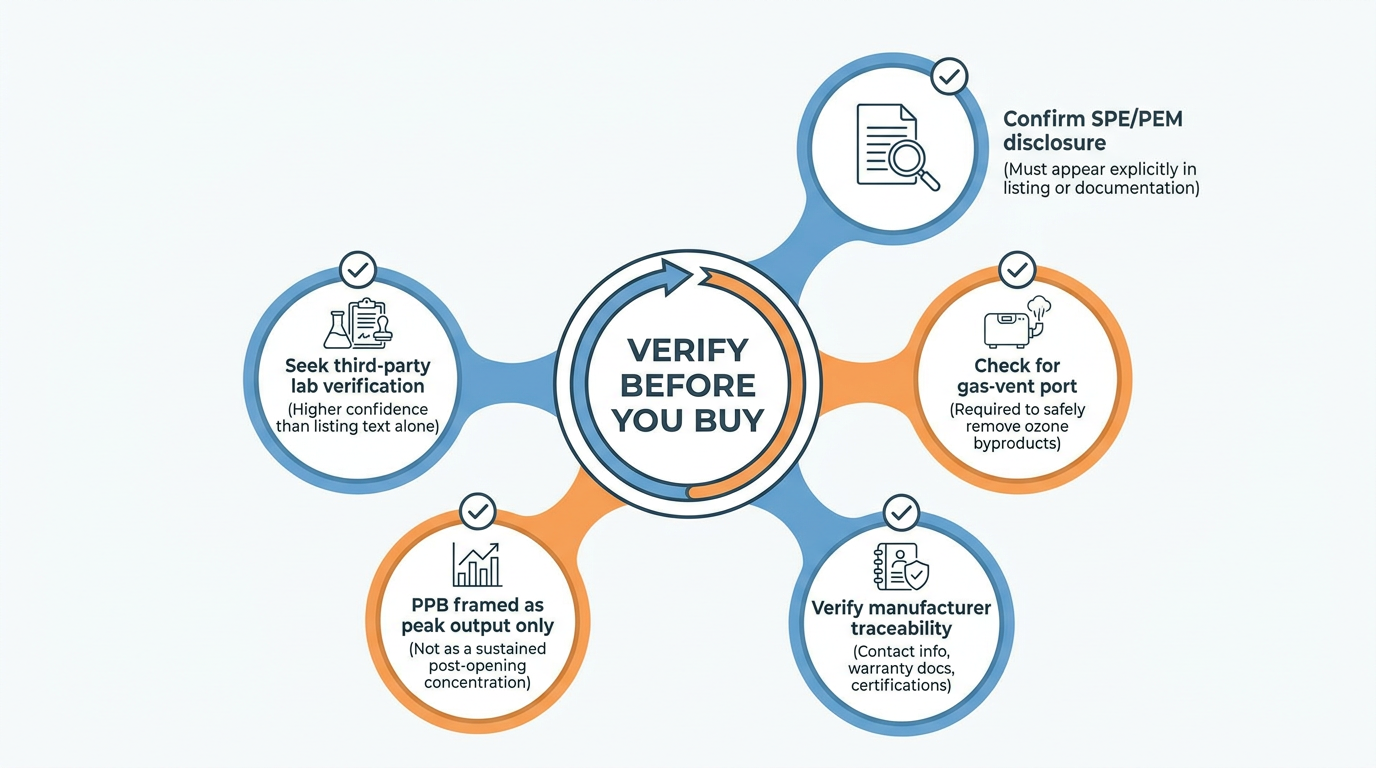
- Powered electrolysis cell confirmed — the product listing or documentation should explicitly state SPE/PEM technology; vague terms like “ionization” or “activation” are not equivalent.
- Visible gas-vent port disclosed — a legitimate SPE/PEM device vents ozone and oxygen byproducts out of the chamber; no vent port means byproducts may enter your water.
- A power source present — corded or rechargeable. If a pitcher requires no electricity at all, it cannot perform electrolysis.
- No SPE/PEM disclosure anywhere — the single most disqualifying red flag. Any pitcher marketed as “hydrogen” without this confirmation is a passive filter with a misleading label.
Comparison Table: The 4 Best Hydrogen Water Pitchers at a Glance
All four pitchers below disclose SPE/PEM technology in their product listings, meeting the minimum qualification standard for a genuine hydrogen water pitcher.
| Product | Capacity | Stated Output | Filtration | Best For | Where to buy |
|---|---|---|---|---|---|
| PIURIFY 50 oz Editor’s Pick | 50 oz | 700-1,300 PPB (listing) | Calcium-sulfite filter | Best overall, countertop home use | CHECK PRICE |
| PUREPEBRIX 72 oz | 72 oz | 3,000 PPB (listing) | None listed | Highest stated output, large households | CHECK PRICE |
| HydroPitcher 68 oz | 68 oz | Not specified | None listed | Large-capacity value pick | CHECK PRICE |
| 2L SPE/PEM Pitcher | 2L (68 oz) | 1,500 PPB (listing) | None listed | Mid-range, standard home use | CHECK PRICE |
All hydrogen output figures reflect manufacturer listing statements only and have not been independently measured. At ordinary pressure, water holds roughly 1.6 mg/L of dissolved hydrogen at equilibrium; high PPB figures describe transient peaks, and HWS has not measured what any pitcher delivers.
The 4 Best Hydrogen Water Pitchers in 2026
Each pitcher below was selected because it explicitly discloses SPE/PEM technology in its product listing — the non-negotiable minimum for a genuine hydrogen water pitcher. PPB figures throughout are listing-stated claims only.
EDITOR’S PICK
1. PIURIFY 50 oz Hydrogen Water Pitcher
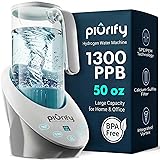
The PIURIFY 50 oz stands as the top overall recommendation for home use, combining SPE/PEM technology with supplementary filtration, and an integrated self-cleaning mode. It is the most complete package among the four reviewed here — and the one that best balances stated performance with post-purchase protection. PIURIFY is also the brand behind the bottle covered in our PIURIFY bottle review.
Why it stands out
- Listing states 700-1,300 PPB output via SPE/PEM technology.
- Includes a replaceable calcium-sulfite filter that improves water taste and pre-infusion quality before hydrogen generation begins.
- Built-in self-cleaning mode helps prevent mineral buildup on electrolysis plates, preserving long-term device efficiency.
Trade-offs to know
- Corded electric operation limits portability; this is a countertop device, not one for travel or gym use.
- Does not remove contaminants such as lead, PFAS, nitrates, or bacteria — users with tap water quality concerns need a dedicated filtration system first.
- Listing PPB figures are manufacturer-stated only and have not been verified by independent measurement.
Who should buy it: Households wanting a countertop SPE/PEM pitcher with long-term warranty support and a supplementary filtration component for everyday use.
Who should skip it: Anyone who needs portability, or whose main concern is contaminant removal rather than hydrogen infusion.
Two ways to buy: CHECK PRICE
HIGHEST STATED OUTPUT
2. PUREPEBRIX 72 oz Hydrogen Water Pitcher

The PUREPEBRIX 72 oz pitcher carries the highest stated PPB figure among the four reviewed models at 3,000 PPB, and its 72-ounce capacity makes it the best fit for high-volume household use. Its listing discloses iridium-platinum electrodes, a material associated with electrode durability and electrolysis efficiency.
Why it stands out
- Listing states 3,000 PPB output — the highest stated figure among the four models reviewed.
- Iridium-platinum electrodes are a listing-disclosed premium material associated with corrosion resistance and sustained electrode performance.
- Auto-clean function supports long-term maintenance and helps preserve output efficiency over time.
- 72 oz capacity is the largest among the reviewed pitchers, well suited for households with multiple daily users.
Trade-offs to know
- High PPB claims require careful scrutiny — water at ordinary pressure holds roughly 1.6 mg/L of dissolved hydrogen at equilibrium, so a 3,000 PPB figure describes a brief peak at most.
- No independent third-party verification of PPB output is available for this product.
- Iridium-platinum electrode claims are listing-stated and have not been reported by third-party testing by a third-party certifier.
Who should buy it: Buyers prioritizing maximum stated output for a large household who understand that peak PPB is a brief opening-moment figure, not a sustained concentration.
Who should skip it: Single users or small households — 72 oz per cycle is more than most solo drinkers will consume before the hydrogen dissipates.
BEST LARGE-CAPACITY VALUE
3. HydroPitcher 68 oz

The HydroPitcher 68 oz is the most accessible entry point among confirmed SPE/PEM pitchers, offering a large 68-ounce capacity at a lower price tier than the PIURIFY or PUREPEBRIX models. Its listing confirms BPA-free construction and SPE/PEM technology — the two non-negotiables for a genuine hydrogen pitcher.
Why it stands out
- BPA-free construction confirmed in the product listing.
- SPE/PEM technology disclosed in listing, qualifying it as a genuine hydrogen water pitcher rather than a passive filter device.
- 68 oz capacity suits family use, producing multiple servings per cycle without frequent refills.
- Lower price tier relative to premium models makes it accessible for budget-conscious buyers entering the category.
Trade-offs to know
- Fewer premium features compared to PIURIFY — no calcium-sulfite filter included.
- Stated output figures are listing claims only, with no third-party verification available.
- Less brand recognition than PIURIFY or PUREPEBRIX warrants careful sourcing from verified sellers.
Who should buy it: Cost-conscious families who want a confirmed SPE/PEM pitcher for daily household use without paying for premium add-ons.
Who should skip it: Buyers who want warranty certainty — the listing does not confirm long-term coverage the way PIURIFY does.
BEST MID-RANGE
4. 2L SPE/PEM Hydrogen Water Pitcher

This 2L SPE/PEM pitcher is a no-frills mid-range option with a listing-stated output of 1,500 PPB and platinum-titanium electrolysis plates. Its 2-litre capacity is the standard countertop home-use size, and SPE/PEM technology is confirmed in the product listing.
Why it stands out
- Listing states platinum-titanium electrolysis plates — a material associated with corrosion resistance and electrode longevity.
- Listing states 1,500 PPB output, above the 700-1,300 PPB range stated by the Editor’s Pick.
- 2L capacity is standard for countertop household use and produces enough for 2–3 servings per cycle.
- SPE/PEM cell confirmed in listing, meeting the core qualification standard.
Trade-offs to know
- Platinum-titanium plate claims are listing-stated and have not been independently verified.
- No self-cleaning mode confirmed in the listing, which may lead to faster mineral buildup without regular manual maintenance. See our cleaning guide for the descaling routine.
- Limited warranty information compared to PIURIFY’s clearly disclosed lifetime coverage.
Who should buy it: Buyers seeking a mid-range SPE/PEM pitcher with above-baseline stated output and food-safe electrode materials, without requiring premium features.
Who should skip it: Anyone unwilling to descale manually — without a self-clean cycle, upkeep is on you.
Pitcher vs. Bottle vs. Generator: Which Format Is Right for You?
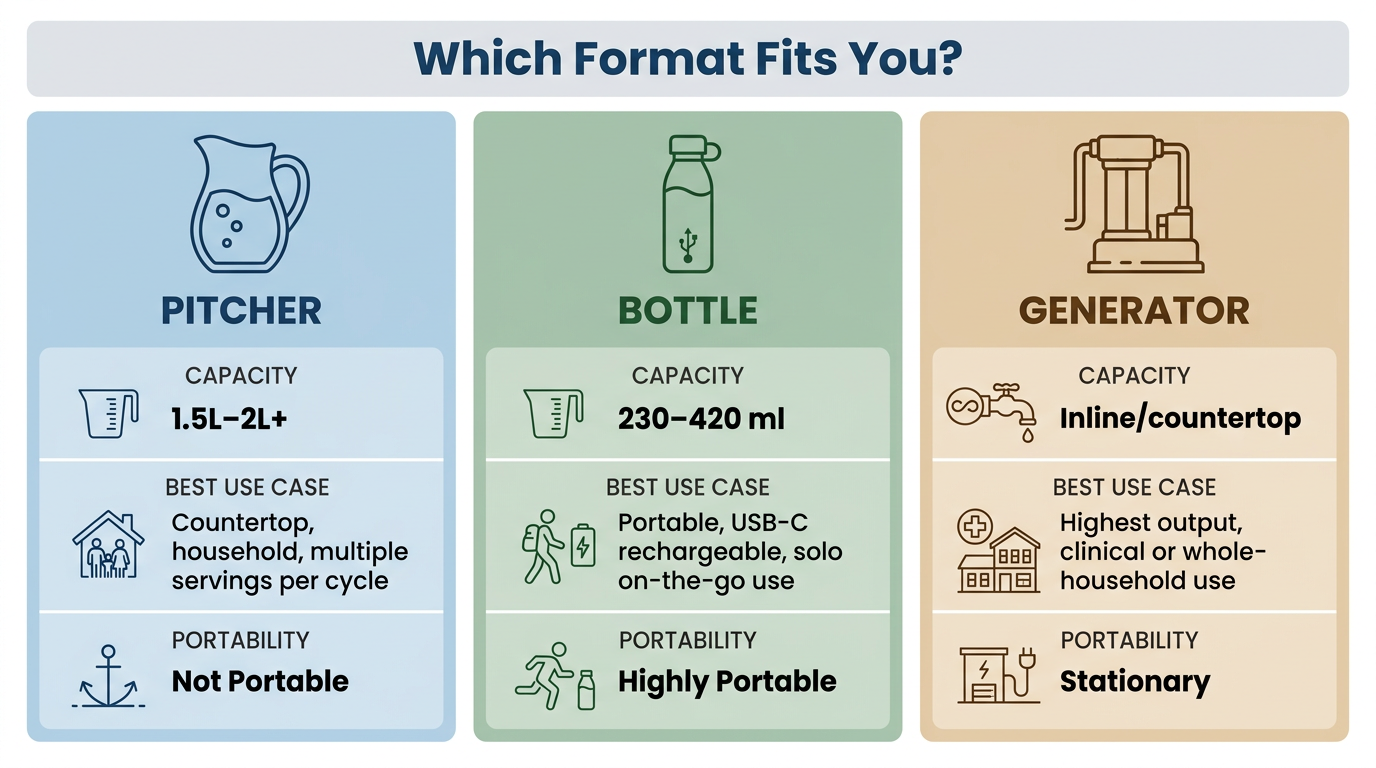
Hydrogen water devices come in three primary formats, each suited to different usage patterns, household sizes, and portability needs.
- Pitcher (1.5L–2L+) — Best for household countertop use. Corded or rechargeable models produce larger volumes per cycle, ideal for multiple daily servings shared across a household. Less portable but significantly higher output per cycle than bottles. All four products reviewed above fall into this category.
- Bottle (230–420 ml) — Compact, USB-C rechargeable, designed for individual on-the-go use: commuting, gym sessions, travel. Lower per-cycle volume means more frequent cycling. See our hydrogen water bottle comparison for that format.
- Generator (countertop) — Highest stated output and production capacity, engineered for whole-household use. Significant upfront investment, and not a practical starting point for first-time buyers. Our hydrogen water generator comparison covers those units. For every product type, browse all hydrogen water reviews.
Who Should Buy a Hydrogen Water Pitcher — and Who Should Skip It
A hydrogen water pitcher is worth considering if you:
- Already use a quality filtration system such as reverse osmosis and want to add hydrogen enrichment on top.
- Prefer a countertop format over a bottle for household servings throughout the day.
- Are willing to verify SPE/PEM disclosure before purchasing and consume water promptly after each cycle.
Skip the pitcher format if you:
- Primarily need water filtration — pitchers infuse H₂ but do not remove lead, PFAS, heavy metals, or bacteria.
- Need portability; a hydrogen bottle is the more practical format for on-the-go use.
- Are not prepared to cross-check SPE/PEM claims against listing documentation — the passive filter market is large enough that uninformed buyers regularly end up with mislabeled products.
What to Avoid: Red Flags That Identify a Fake or Unsafe Hydrogen Water Pitcher
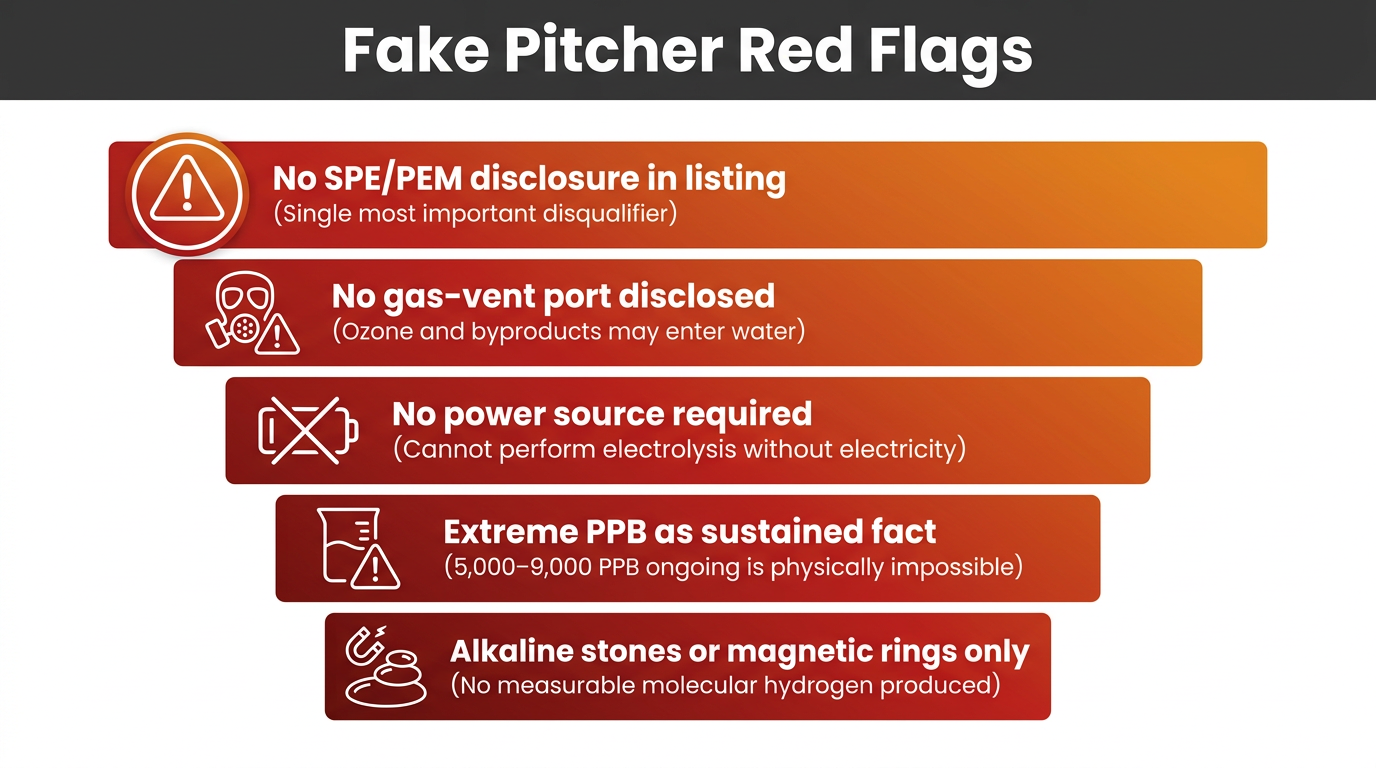
The hydrogen water market has a well-documented gap between manufacturer PPB claims and what devices actually deliver in practice — one reason mislabeled and underperforming products are common in this category. Before purchasing any hydrogen water pitcher, watch for these disqualifying red flags:
- No SPE/PEM disclosure anywhere in the listing or product documentation — the single most important disqualifier. If a manufacturer does not explicitly confirm SPE/PEM technology, the device cannot be verified as genuine, regardless of what the label says.
- No visible gas-vent port disclosed — a legitimate SPE/PEM device vents ozone and oxygen byproducts out of the water chamber. No disclosed vent means unwanted gases may enter the water directly.
- Unnamed or unverifiable manufacturer with no contact information, warranty documentation, or third-party certifications.
- PPB claims presented as sustained fact — claims of 5,000–9,000 PPB as a continuous dissolved concentration after opening sit far above the roughly 1.6 mg/L equilibrium solubility at ordinary pressure. Any listing presenting extreme PPB figures as ongoing performance rather than brief peak output is using misleading marketing language.
- “Hydrogen” branding on passive filter pitchers using only alkaline stones, magnetic rings, or ceramic media with no powered electrolysis cell — these produce no measurable molecular hydrogen and are fundamentally mislabeled.
The Bottom Line
Real SPE/PEM hydrogen water pitchers exist and are worth considering for health-conscious households — provided buyers apply the right verification criteria before purchasing. The minimum qualification is non-negotiable: a powered SPE/PEM electrolysis cell with a disclosed gas-vent port. Any pitcher without this confirmed in its listing is a passive filter with a misleading label, regardless of the PPB numbers printed on the box.
If you want the most complete package, the PIURIFY 50 oz is the pick — calcium-sulfite filtration and self-cleaning in one unit. For the largest capacity and highest stated output, the PUREPEBRIX 72 oz is the alternative. Verify before you buy, not after.
Editor’s Pick: CHECK PRICE
Frequently Asked Questions
Are hydrogen water pitchers real, or are they just regular filter pitchers with a marketing label?
Genuine hydrogen water pitchers do exist and are distinguished by a powered SPE/PEM electrolysis cell that generates measurable molecular hydrogen. However, a large portion of products marketed as “hydrogen” use only passive filtration media such as alkaline stones or magnetic rings. These produce no measurable H₂ and are fundamentally mislabeled. Always confirm SPE/PEM disclosure before purchasing.
How long does hydrogen stay in the water after the pitcher finishes a cycle?
Dissolved molecular hydrogen is unstable and begins off-gassing immediately after production. Listing-stated PPB figures reflect peak output at the moment of production; once the container is opened, concentration drops rapidly. For the highest dissolved H₂, drink hydrogen water promptly after production.
Can a hydrogen water pitcher also filter out contaminants like lead or PFAS?
Hydrogen water pitchers are designed for hydrogen infusion, not contaminant removal. Some models, like the PIURIFY 50 oz, include supplementary calcium-sulfite filters that improve water taste and pre-infusion quality — but these do not remove heavy metals, PFAS, nitrates, or bacteria. A dedicated reverse osmosis or activated carbon system should serve as your primary water quality baseline before hydrogen enrichment.
What does SPE/PEM technology mean, and why does it matter for safety?
SPE (Solid Polymer Electrolyte) uses a polymer membrane to generate hydrogen gas efficiently. PEM (Proton Exchange Membrane) works alongside it, allowing only protons to pass while separating and venting unwanted byproduct gases — primarily ozone and chlorine — away from the drinking water. Without PEM separation, those byproducts are not vented, meaning ozone may enter the water you drink.
How should I evaluate a hydrogen water pitcher before buying?
Start with listing verification: confirm explicit SPE/PEM disclosure, a visible gas-vent port, a traceable manufacturer with warranty documentation, and PPB claims framed as peak output rather than sustained concentration. If the listing does not confirm SPE/PEM technology, no other specification — PPB figures, electrode materials, or price point — qualifies the product as a genuine hydrogen water pitcher.
Medical disclaimer: The information on this page is for general informational purposes only and does not constitute medical advice. Hydrogen water is a wellness product, not a treatment, and is not intended to diagnose, treat, cure, or prevent any disease. Consult a qualified healthcare provider before making changes to your diet or hydration routine. See our full medical disclaimer.
Last update on 2026-10-22 / Affiliate links / Images from Amazon Product Advertising API
This product presentation was made with AAWP plugin.